Scientists have discovered a revolutionary treatment that makes you live longer.
- It enhances your memory and makes you more creative.
- It makes you look more attractive.
- It keeps you slim and lowers food cravings.
- It protects you from cancer and dementia.
- It wards off colds and the flu.
- It lowers your risk of heart attacks and stroke, not to mention diabetes.
You’ll even feel happier, less depressed, and less anxious.
Are you interested?
If this were a pill, people would pay thousands of dollars for the smallest dose. Pharmaceutical companies would fight wars over the patent.
But it isn’t a pill. It’s free. It’s available to everyone, every night.
It’s sleep.
Yet, we ignore it. We view sleep as an adversary, an obstacle to productivity, a sign of weakness, or a bank we can borrow from and pay back later.
We live by the fatalistic maxim: I’ll sleep when I’m dead.
Matthew Walker, a professor of neuroscience and psychology at UC Berkeley, has a simple response to that mindset: If you adopt that philosophy, you will be dead sooner, and the quality of that shorter life will be worse.
The physical evidence is stark. For example, men who routinely sleep just four to five hours a night have a level of testosterone which is that of someone ten years their senior.
Lack of sleep ages you by a decade.
We are currently in the midst of a catastrophic sleep-loss epidemic. The World Health Organization has declared a sleep loss epidemic throughout industrialized nations.
It is time to stop thinking of sleep as the absence of wakefulness. Sleep is an active, vital metabolic state.
It is the foundation on which the other two pillars of health, diet and exercise, sit. Take away the bedrock of sleep, and the other two collapse.
This longform unpacks the science of why we sleep and the dire consequences of ignoring it. By the end, you will discover:
- Why the recycling rate of a human being is exactly 16 hours.
- The invisible biological mechanism linking short sleep to Alzheimer's and cancer.
- Why you can never catch up on lost sleep.
- The five modern enemies silently ruining your nights, and the protocol to defeat them.
The 1-Minute Summary
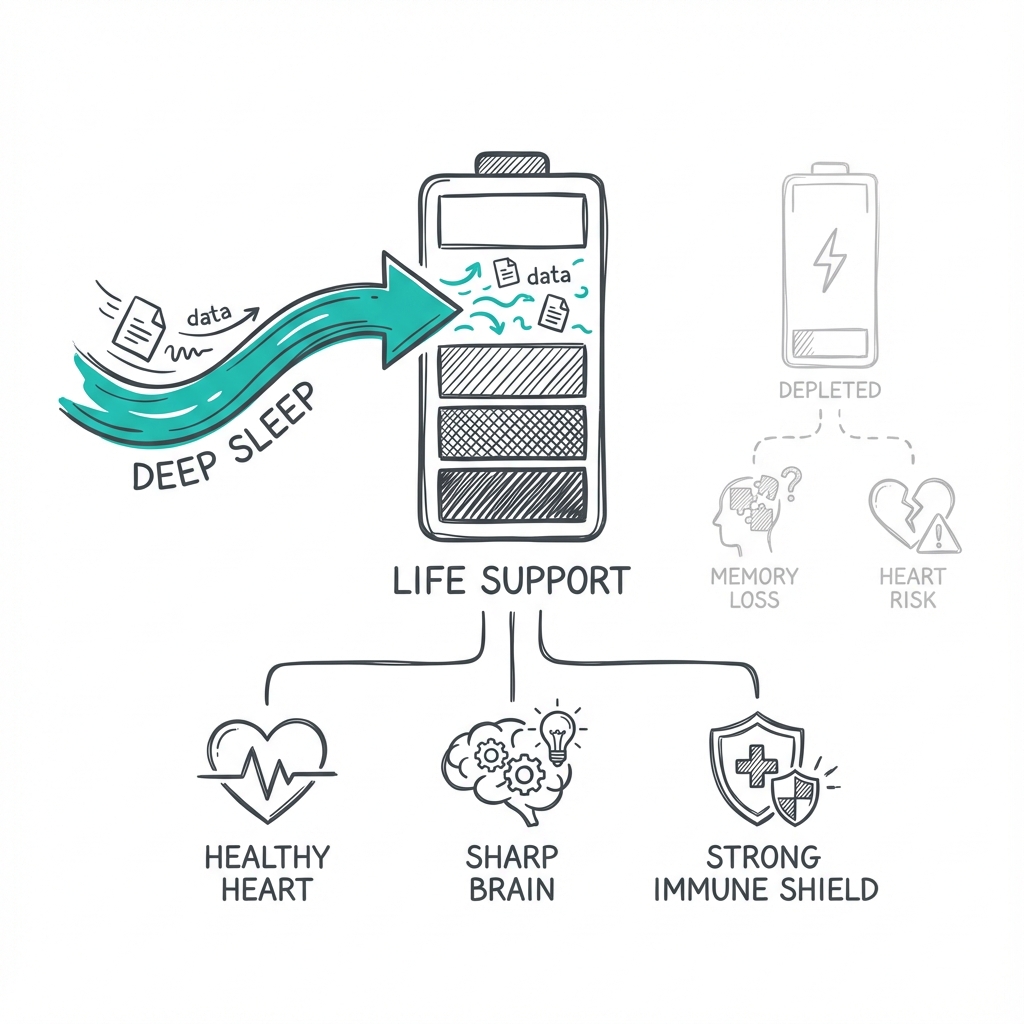
Sleep is not a luxury. It is a non-negotiable biological necessity. It is your life-support system.
Every major disease in the developed world has strong causal links to deficient sleep. These include Alzheimer's, cancer, obesity, and diabetes.
We tend to think of sleep as a single state, but it is a complex series of stages. NREM (Non-Rapid Eye Movement) sleep weeds out unnecessary neural connections and moves memories to long-term storage. REM (Rapid Eye Movement) sleep strengthens the remaining connections and offers emotional therapy. You need both.
Key Insights:
- The 16-Hour Limit. After 16 hours of wakefulness, the brain begins to fail. You need more than 7 hours of sleep to maintain cognitive performance.
- The Bank is a Myth. You cannot accumulate a sleep debt during the week and pay it off on the weekend. The damage to your brain and body is immediate and often irreversible.
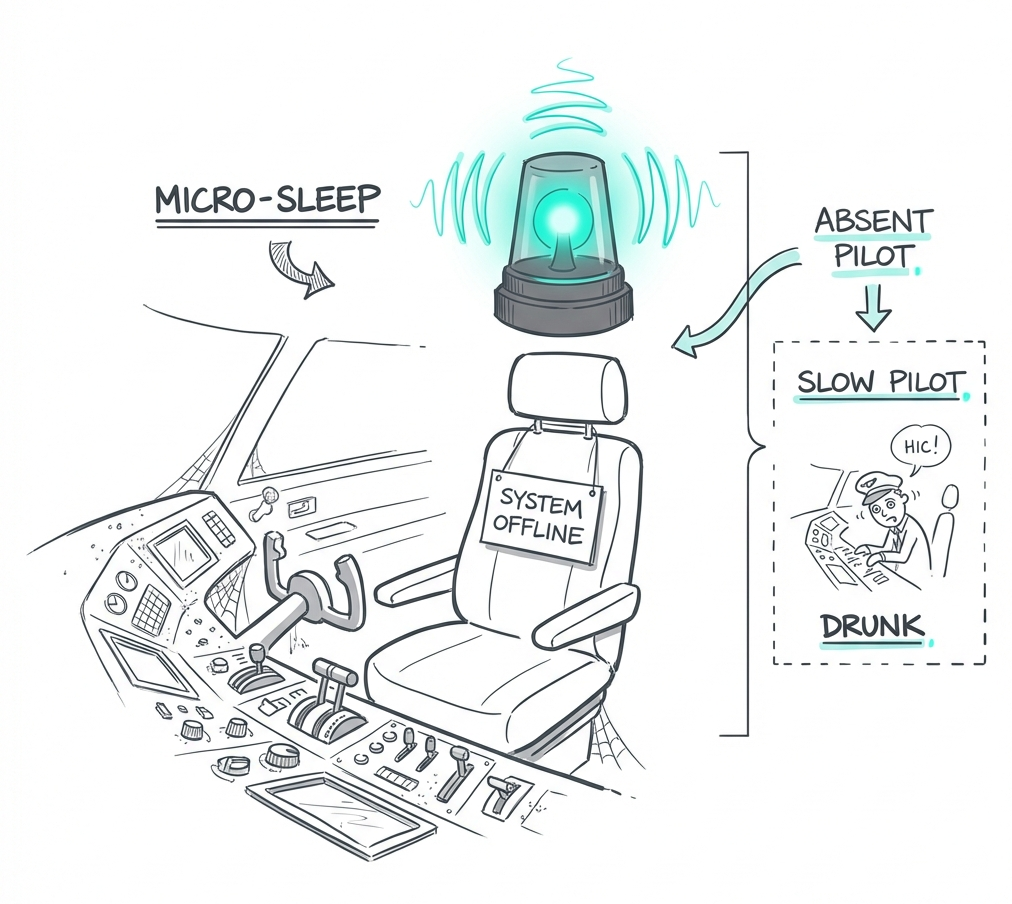
- Drowsy Driving Kills. Driving after sleeping less than 5 hours is as dangerous as driving drunk.
- Alzheimer’s Link. Deep sleep cleanses the brain of beta-amyloid, the toxic protein linked to Alzheimer's. Less sleep means more toxic buildup.
- Cancer & Immunity. A single night of 4 hours of sleep sweeps away 70% of your natural killer cells. The immune system's first defense against cancer.
- Sleep Pressure. The urge to sleep is driven by adenosine. Caffeine doesn't reduce adenosine. It just mutes the signal, leading to a massive crash later.
Module 1
The Mechanics of Slumber
Your wakefulness is not determined by a single switch. It is a constant battle between two opposing forces.
1. The Two Forces
At this very moment, two systems are fighting for control of your brain.
The first is Process C, or the Circadian Rhythm.
This is your internal twenty-four-hour clock. Located deep in the brain (in the suprachiasmatic nucleus), it broadcasts a signal to every region of your brain and every organ in your body.
It creates a cycling rhythm that makes you feel tired or alert at regular times. It controls your body temperature, your metabolism, and your hormones.
Crucially, it is endogenous, meaning it is self-generated. Even if you were sealed in a dark cave for weeks, your body would still cycle through a rhythm of roughly 24 hours and 15 minutes.
Sunlight acts as the manipulating finger that resets this inaccurate clock back to a precise 24-hour day.
The second is Process S, or Sleep Pressure (driven by adenosine). While your Circadian Rhythm oscillates up and down, the second force is linear.
From the moment you wake up, a chemical called adenosine begins to build up in your brain. Think of it like a chemical barometer. It registers the amount of time that has elapsed since you woke up.
The longer you are awake, the more adenosine accumulates. The more it accumulates, the greater the sleep pressure.
After about 12 to 16 hours of being awake, adenosine levels are high enough to create an irresistible urge to sleep. When you finally succumb to sleep, the brain goes into evacuation mode, clearing out the day's adenosine.
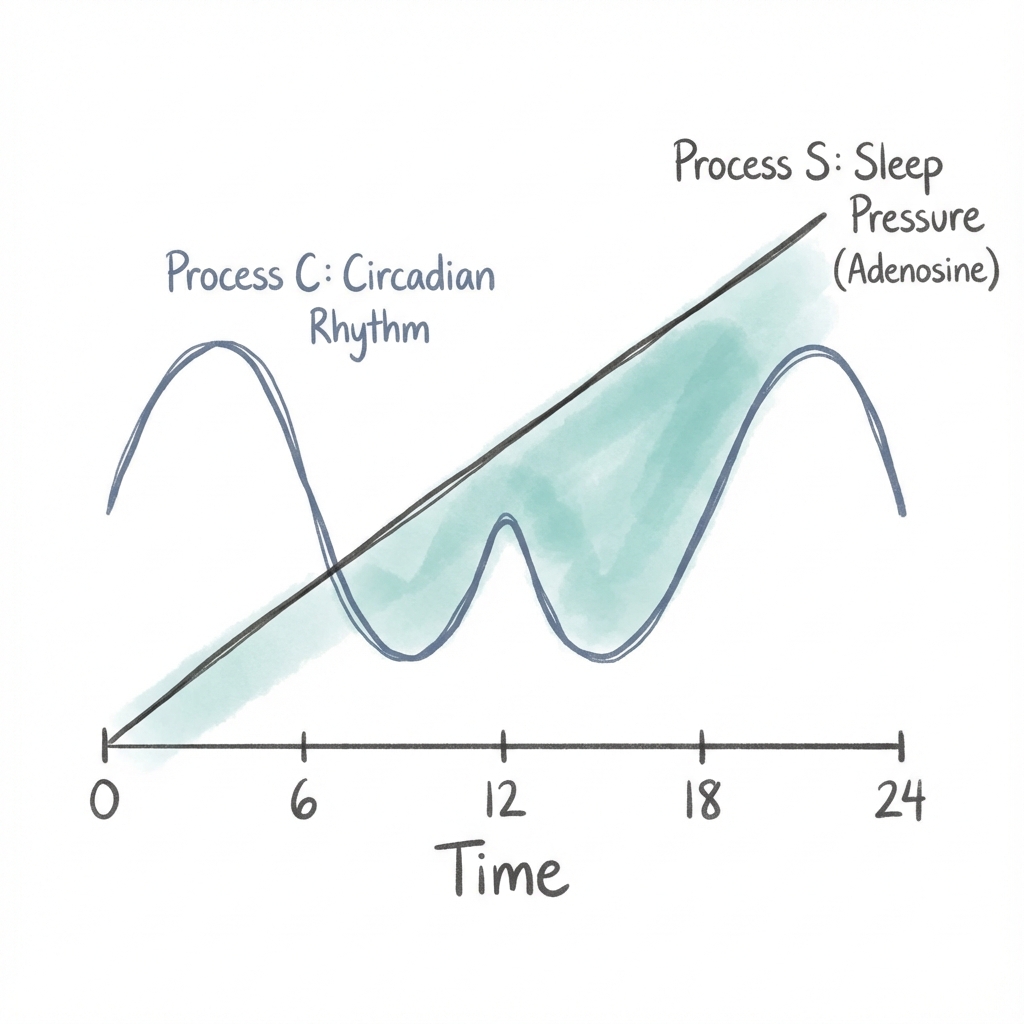
These two systems usually work together, but they are independent. This explains the second wind you get during an all-nighter. If you stay up all night, your adenosine (sleep pressure) keeps rising. You feel miserable. But around 11:00 AM the next morning, you might suddenly feel more alert. Why?
Because your Circadian Rhythm (Process C) has swung back up to its peak. It is shouting Wake up! so loud that it temporarily drowns out the screaming Sleep! signal from the adenosine.
But it doesn't last. When the Circadian Rhythm dips again that evening, the crash is catastrophic.
2. The Caffeine Deception
Caffeine is the most widely used psychoactive stimulant in the world. It works by sabotage.
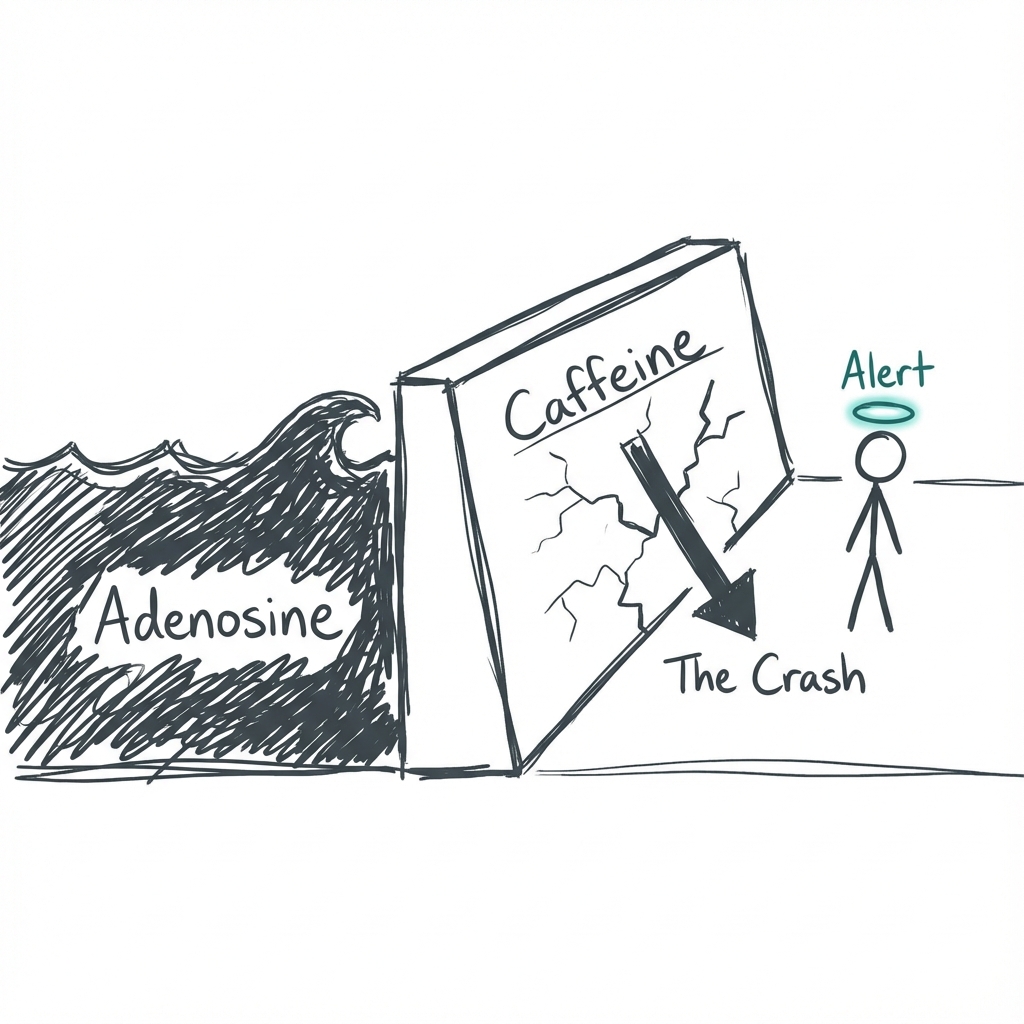
Caffeine jams the radar. It latches onto the adenosine receptors in your brain, blocking them. Your brain is still flooded with sleep-inducing adenosine, but it can no longer detect it.
You feel alert. But the adenosine doesn't stop building up just because you can't feel it.
This leads to the crash. When the caffeine finally wears off (it has a half-life of 5-7 hours), the dam breaks. You are hit with the adenosine that was already there, plus all the extra adenosine that built up while you were caffeinated. This is the caffeine crash. It is an avalanche of sleep pressure.
3. The Architecture of the Night
Sleep is not a uniform state. It is a complex cycle of two completely different types of slumber: NREM (Non-Rapid Eye Movement) and REM (Rapid Eye Movement).
They battle for dominance every 90 minutes.
The first phase is NREM (Non-Rapid Eye Movement), often called The Weeder. Deep NREM sleep dominates the first half of the night. This is a state of neural reflection.
During this phase, your brainwaves slow down to a powerful, rhythmic chant. These slow waves act like a courier service, transferring memories from the fragile, short-term storage of the hippocampus to the permanent, long-term storage of the cortex.
It also performs "synaptic pruning." It weeds out unnecessary neural connections so you don't wake up with a brain cluttered with useless information.
The second phase is REM (Rapid Eye Movement), or The Integrator. REM sleep dominates the second half of the night (especially the early morning hours). This is the state of dreaming.
Brain activity during REM looks almost identical to being awake. It is a state of emotional first-aid and creative association. If NREM weeds the garden, REM feeds and waters it, making new connections between disparate pieces of information.
Because the two types of sleep are distributed unevenly, cutting your sleep short has disproportionate consequences. This is the 6:00 AM Tragedy. If you go to sleep at midnight and wake up at 6:00 AM instead of 8:00 AM, you lose 25% of your total sleep.
But you might lose 60-90% of your REM sleep.
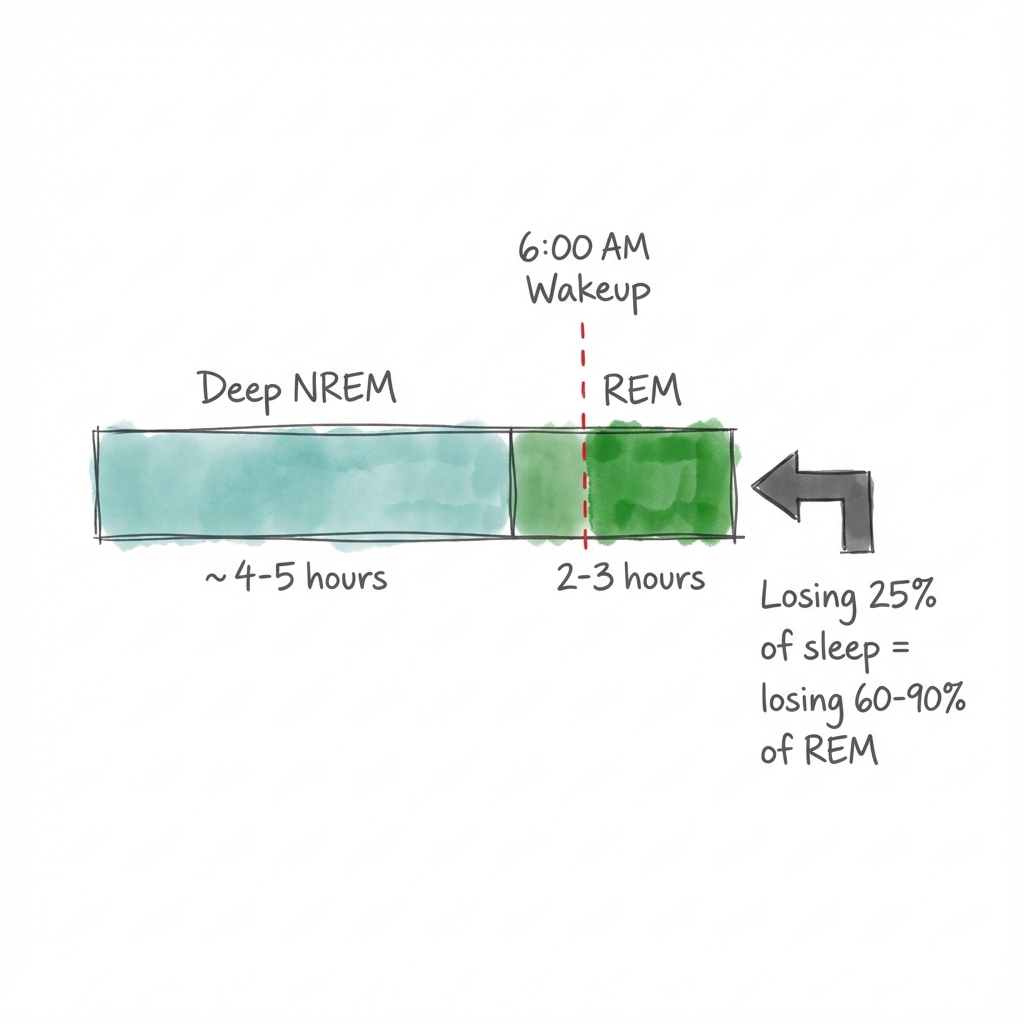
By cutting off the end of the night, you are amputating the phase of sleep responsible for emotional stability and creativity. This explains why we are so groggy, irritable, and uncreative when we wake up too early. We have starved the brain of its emotional therapy.