In his twenties, Naval Ravikant was broke and desperate.
He had immigrated from India as a child, grown up in a single-bedroom apartment in Queens, and now found himself grinding through low-paying jobs while chasing startup ideas that went nowhere. He was anxious. He was unhappy. He was, by his own admission, miserable.
Then something shifted.
He didn't win the lottery. He didn't inherit money. He figured something out.
By his forties, Naval was worth hundreds of millions of dollars. He had co-founded AngelList and made early investments in Uber, Twitter, and Postmates.
But more remarkably, he was at peace.
Not the fake peace of someone suppressing their emotions. Real peace. The kind that lets you sit alone in a room for an hour without reaching for your phone.
I was born poor and miserable. I'm now pretty well-off, and I'm very happy. I worked at those. — Naval Ravikant
This claim sounds arrogant until you realize what it implies.
If Naval worked at wealth and happiness, they are not accidents of birth. They are not gifts from the universe.
They are skills.
Most of us see wealth and happiness as opposing forces. To get rich, we assume we must sacrifice our peace. To be happy, we assume we must renounce ambition.
Naval disagrees.
He argues that if you understand the math of leverage, you can build wealth without grinding yourself into dust. If you understand the biology of desire, you can find peace without retreating to a cave.
The Almanack, curated by Eric Jorgenson, is a collection of Naval's wisdom. It strips away the fluff and delivers the mental models required to win both games.
By the end, you will discover:
- Why wealth is a skill you can reproduce even if you lost everything.
- Why an army of robots is the ultimate lever for the modern age.
- Why certainty is the biggest obstacle to making great decisions.
- How to remove the "unhappiness contract" you signed with yourself.
- Why you are the only one who can save yourself.
- Moving from independence to true sovereignty.
The 1-Minute Summary
Life consists of two massive games: the Wealth Game and the Happiness Game.
Most people play both poorly because they rely on hard work for the first and external validation for the second.
The Wealth Thesis
Wealth is not a function of hours worked. It is the result of Specific Knowledge applied with Leverage.
- Specific Knowledge is the thing you do that feels like play to you but looks like work to others. It is authentic to your DNA, meaning no one can compete with you on it.
- Leverage is the force multiplier (Capital, Labor, Code, or Media) that disconnects your inputs from your outputs, allowing you to earn while you sleep.
The Happiness Thesis
Happiness is a default state of peace that emerges when you remove the sense that something is missing.
- Desire is a contract you make with yourself to be unhappy until you get what you want.
- Freedom goes beyond financial independence. It includes freedom from your own uncontrolled reaction to the world.
Success is winning the wealth game so you can stop playing it. Happiness is realizing you never needed to play the status game in the first place.
Module 1
The Principles of Wealth
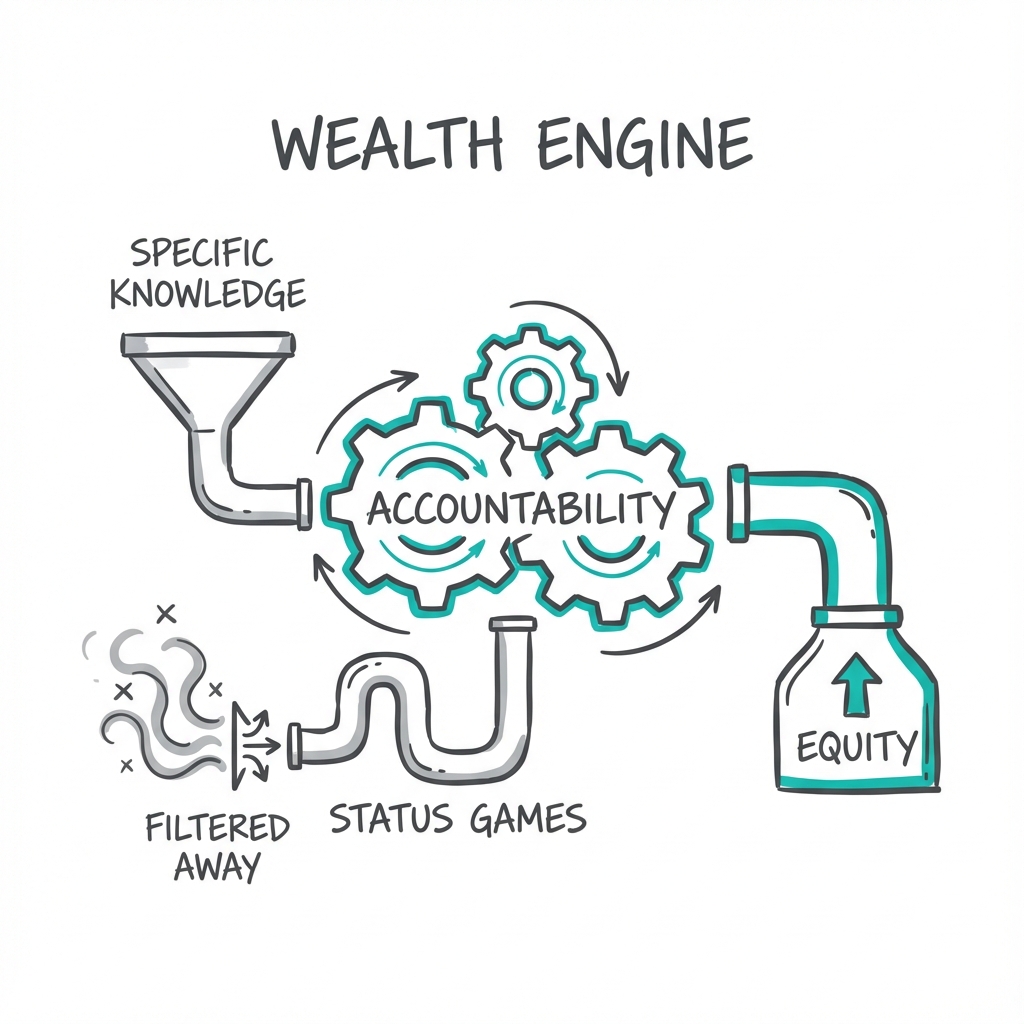
There is a common misconception that getting rich is about luck.
If you play the lottery and win, that is luck.
If you bet everything on a penny stock and it 100x’s, that is luck.
But if you were to take a wealthy person like Elon Musk or Warren Buffett, strip them of all their money, and drop them in a random English-speaking country, they would be wealthy again within ten years.
Making money is a skill.
To master this skill, you first have to know what you are chasing.
You do not want money. You want wealth.
- Money is how we transfer time and wealth. It is a social credit.
- Status is your place in the social hierarchy. It is a zero-sum game.
- Wealth is assets that earn while you sleep. It is the factory, the code, the brand, the investment portfolio.
The goal is to build wealth. And the most dangerous trap preventing you from building wealth is playing Status Games.
Status is an old game.
It predates civilization. In a hunter-gatherer tribe, status determined who ate first and who mated. It is deeply wired into our biology.
But status is a zero-sum game.
To win, you must put others down.
Wealth, by contrast, is a positive-sum game.
We can all be wealthy. We can all build houses, write code, and create abundance.
The problem arises when people link their self-worth to status. They attack wealth creation to look morally superior in the status hierarchy.
Avoid status games.
They make you an angry, combative person. Play Wealth Games instead.
Productize Yourself
Naval summarizes his entire philosophy of wealth creation in two words: Productize Yourself.
This is the core formula.
- Yourself has uniqueness. It has accountability. It has specific knowledge.
- Productize has leverage. It has scale. It has a disconnect between inputs and outputs.
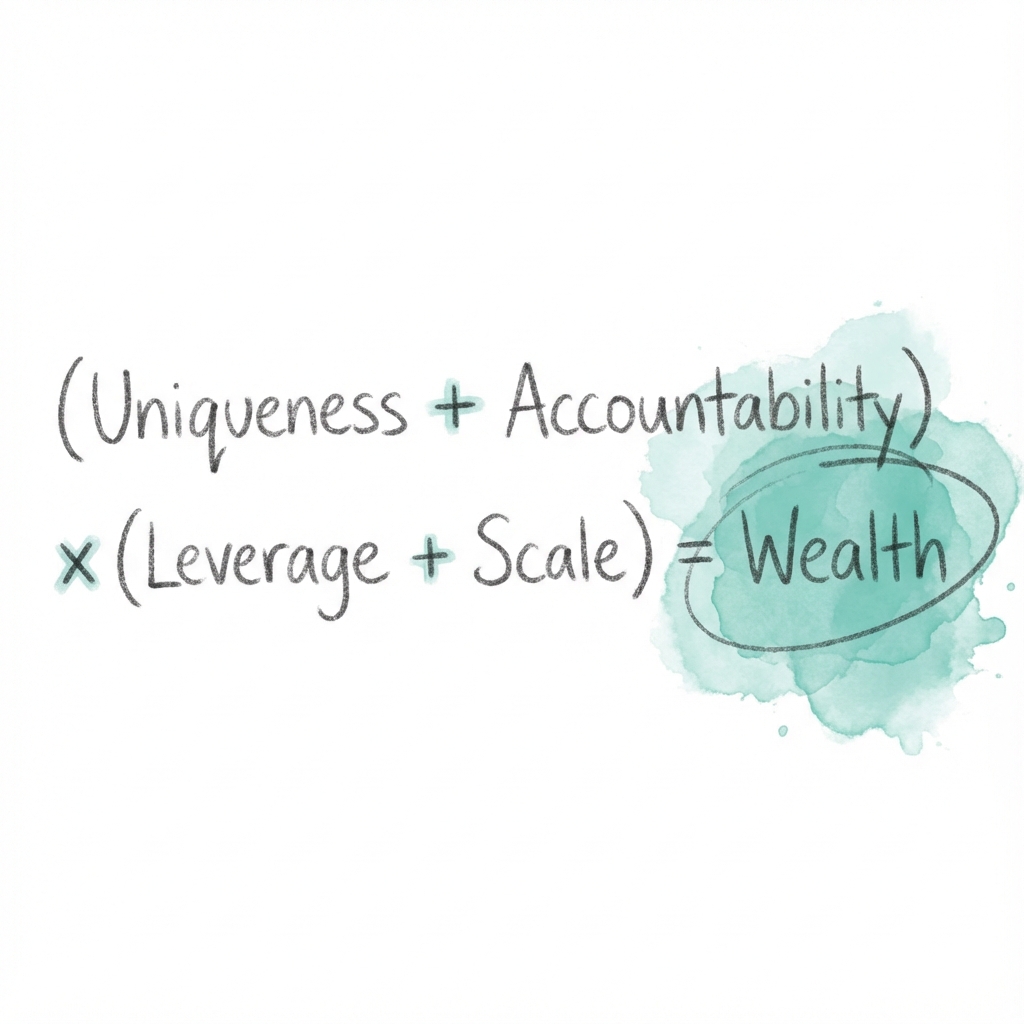
If you are looking for a long-term career, you need to ask: "Is this authentic to me? And am I scaling it?"
You cannot get rich renting out your time. You are not going to become a billionaire (or even financially free) by working for an hourly wage, even if that wage is $1,000 an hour. As long as your input (time) is tied to your output (money), you are trapped.
You must own equity. You must own a piece of a business. You must Productize Yourself.
Specific Knowledge
To Productize Yourself, you must first uncover what you are uniquely good at. Naval calls this Specific Knowledge.
Specific knowledge cannot be taught in schools.
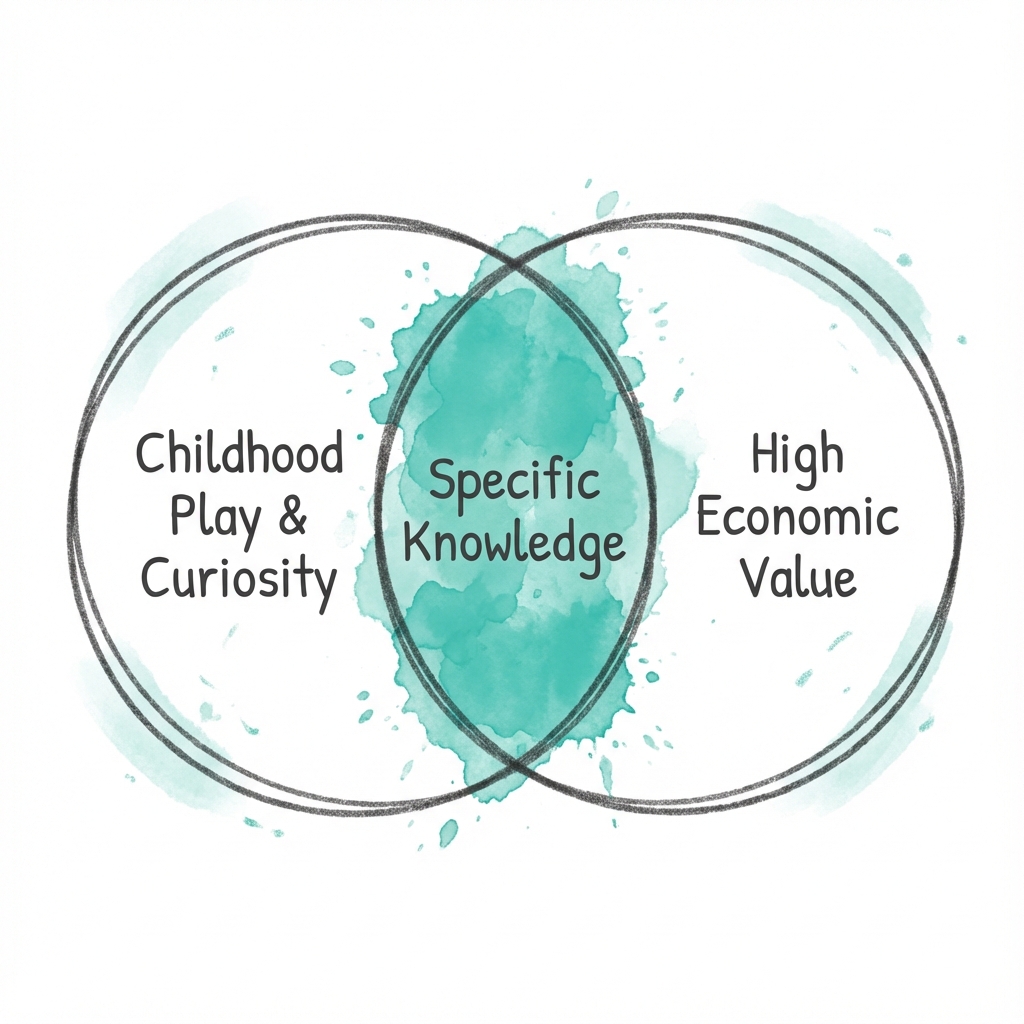
If society can train you to do something, it can train someone else to replace you. If you can be replaced, your margin will be competed down to zero.
Specific knowledge is found by pursuing your genuine curiosity and passion rather than whatever is hot right now.
Specific knowledge feels like play to you, but looks like work to others.
- To the person analyzing stock charts for fun on a Sunday morning, it’s play. To the person doing it for a paycheck, it’s torture. The person playing will always outwork the person working.
- To the kid reading sci-fi novels and learning computer logic, it’s play. To the student forced to learn coding syntax, it’s a chore.
When you are building specific knowledge, you are not competing. You are escaping competition through authenticity.
No one can compete with you on being you.
I'm always working. It looks like work to others, but it feels like play to me. And that's how I know no one can compete with me on it. Because I'm just playing, for sixteen hours a day. If others want to compete with me, they're going to work, and they're going to lose. — Naval Ravikant
Specific knowledge is often highly technical or creative. It cannot be outsourced or automated. It is usually at the edge of knowledge, the stuff that is just being figured out right now.
Look back at your childhood. What were you doing effortlessly that others found difficult?
- Were you the kid negotiating with teachers? (Sales)
- Were you the kid organizing the neighborhood games? (Management)
- Were you the kid taking apart the radio? (Engineering)
When you combine your specific knowledge with the ability to sell it and build it, you become hard to compete with.
- Learn to Sell: Marketing, communication, recruiting, raising money.
- Learn to Build: Coding, design, manufacturing, logistics.
If you can do both, you are a unicorn. If you can only do one, find a partner who can do the other. But start with the Specific Knowledge that is unique to you.
Once you have found what you should be doing, the next step is to apply the force multiplier that turns effort into wealth: Leverage.