Antaeus was a giant in Greek mythology, the son of Poseidon and Mother Earth.
He had a strange hobby: he forced passersby to wrestle him to the death. And he was invincible. But there was a trick. He derived his strength from physical contact with his mother, the Earth. As long as his feet touched the ground, he could not be defeated.
Hercules, tasked with killing him, figured this out. He didn't try to outpower Antaeus. He simply lifted him off the ground. Severed from his roots, the giant lost his power and was crushed.
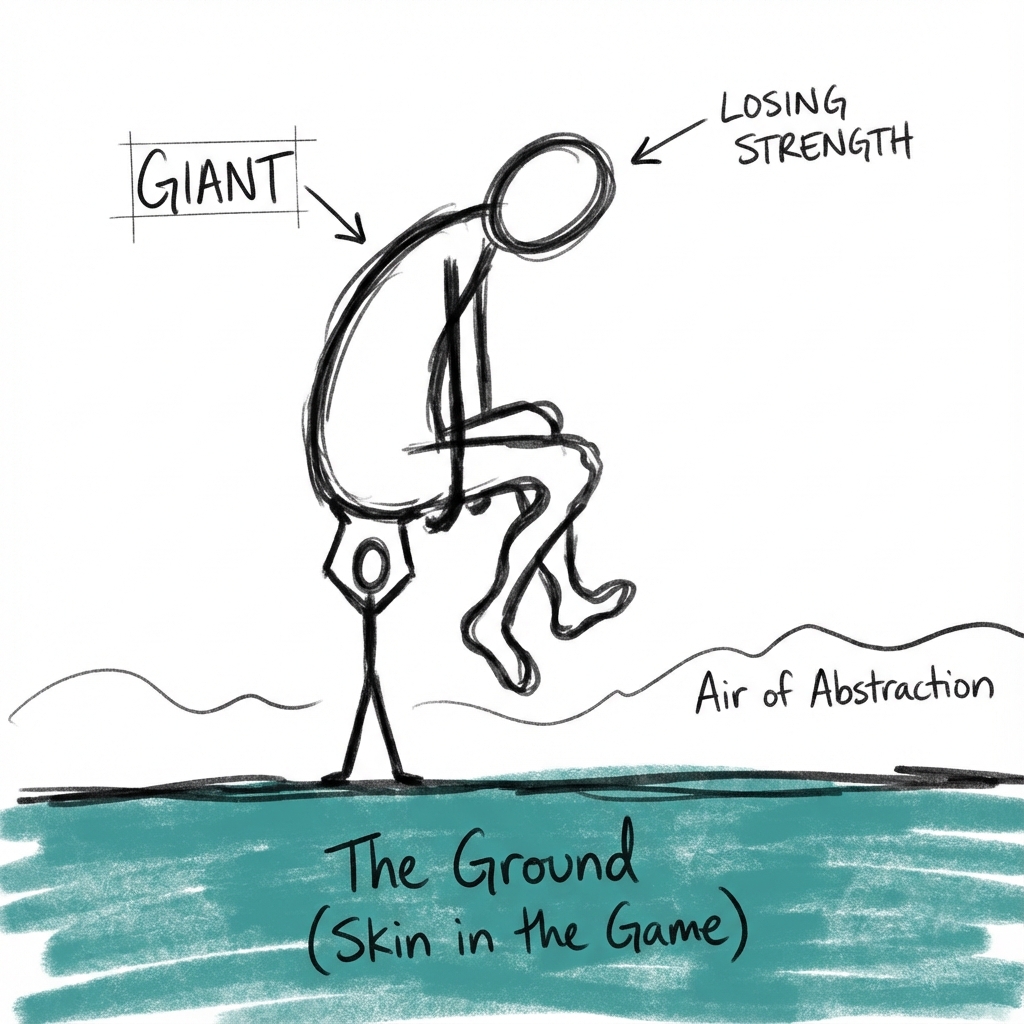
This myth is the central metaphor of Nassim Nicholas Taleb's Skin in the Game.
We are currently ruled by a class of people who, like Antaeus held aloft, have no contact with the ground. They are bureaucrats, bankers, pundits, and interventionistas who make decisions that affect millions (invading countries, bailing out banks, regulating industries) without ever feeling the consequences when things go wrong.
They have severed the link between reward and risk.
They keep the upside and transfer the downside to you.
Most people think skin in the game is just an idiom about financial incentives, such as a CEO owning stock in his company. Taleb argues it is actually the central mechanism of the universe. It is how evolution works (the incompetent die). It is how justice works (an eye for an eye). It is how knowledge works (you learn through pain, not textbooks).
Here's what most people miss: A committed minority of just 3% can force an entire society to submit to their preferences. Your bottled water is Kosher not because the majority demands it, but because a tiny fraction refuses anything else. The flexible majority folds to the intransigent few. This asymmetry explains everything from the spread of religions to moral revolutions to why your grocery store carries organic food.
Without skin in the game, reality is replaced by abstraction. Systems accumulate hidden fragility. And eventually, they collapse.
This longform distills the signal from Taleb's most practical work.
By the end, you will discover:
- Why the world accumulates "hidden stupidity" whenever we remove the penalty for being wrong.
- Why a tiny, stubborn minority of 3% can force an entire nation to eat what they eat.
- Why your company prefers to hire you for your "two cats and a mortgage" rather than your skills.
- Why you should never trust a surgeon who looks exactly like a surgeon.
- Why the Silver Rule is a far more robust way to navigate ethics than the Golden Rule.
- Why rationality has nothing to do with logic and everything to do with avoiding total ruin.
The 1-Minute Summary
Skin in the Game (SITG) is a symmetry filter. In any transaction or system, the person making the decision must share in the risk of the outcome. If they don't, the system accumulates hidden risks and eventually collapses.
The modern world is plagued by agency problems where decision-makers transfer tail risk (catastrophic downside) to others. This transfer of fragility is the root of war, financial crises, and social unrest.
Key Concepts:
- The Silver Rule: "Do not do to others what you would not like them to do to you." This is more robust than the Golden Rule because it focuses on preventing harm via via negativa (subtraction).
- The Minority Rule: A small, intransigent minority (3 to 4 percent) will force the flexible majority to submit to their preferences (e.g., eating Kosher/Halal, non-GMOs).
- The Intellectual Yet Idiot (IYI): The semi-educated expert who understands first-order logic but fails to comprehend complex systems, judging reality by textbooks rather than survival.
- Ergodicity: The difference between the group average and the individual's journey. If a risk carries a possibility of ruin (going to zero), cost-benefit analyses are useless. Rationality is strictly defined as survival.
- Lindy Effect: The life expectancy of a non-perishable idea or technology is proportional to its current age. Time is the only effective judge of quality.
Module 1
The Symmetry of Reality
Most people think skin in the game is just an idiom about financial incentives. Taleb flips this. Skin in the game is the very foundation of existence.
It is a filter.
In nature, bad designs don't survive. If a wolf is a bad hunter, it starves. If a bridge builder is incompetent, the bridge collapses. This filtering mechanism (the direct feedback loop between action and consequence) is what prevents the accumulation of stupidity and fragility.
When you remove skin in the game, you stop the filter. You allow incompetence to survive and propagate.
1. The Bob Rubin Trade
To understand the danger of removing this filter, look at the Bob Rubin trade.
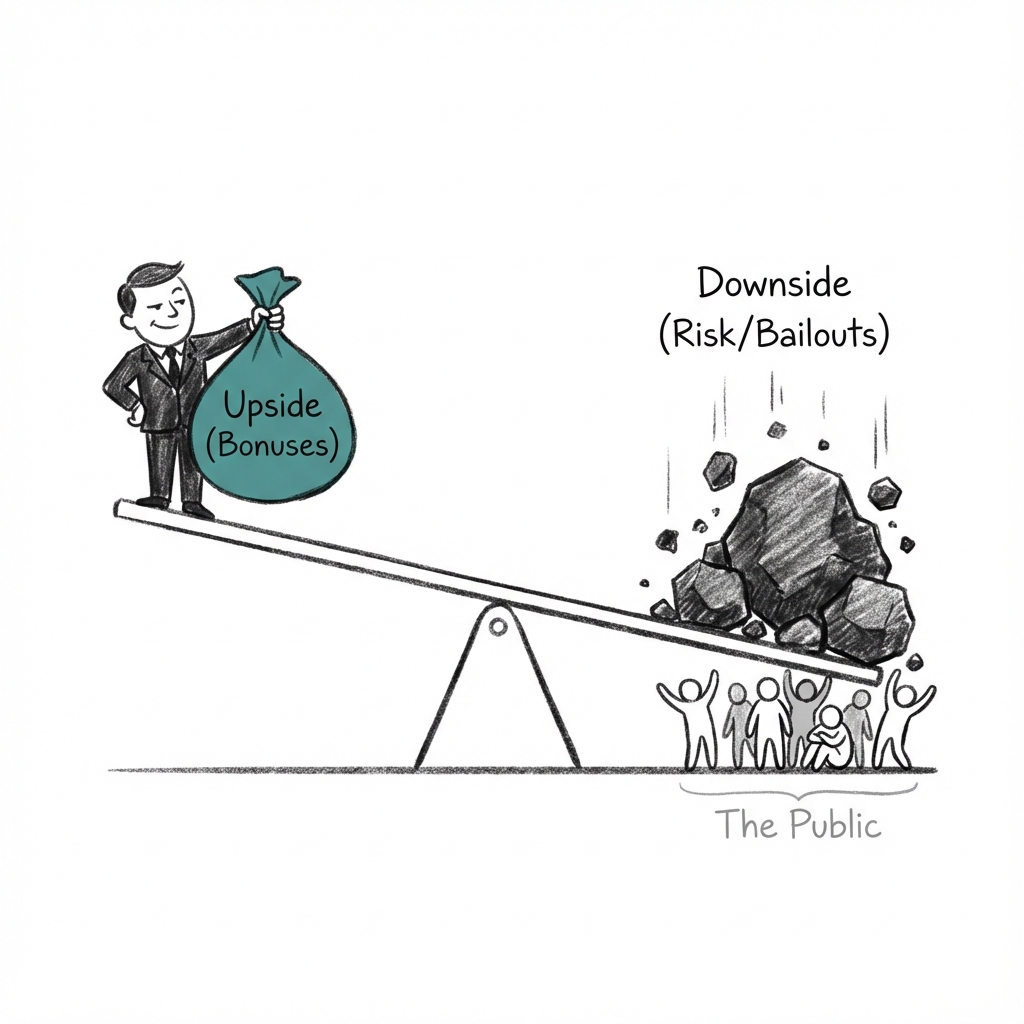
Robert Rubin was a former U.S. Treasury Secretary and a director at Citigroup. In the decade leading up to the 2008 financial crash, he collected over $120 million in compensation. When the bank inevitably blew up due to the risks he and his colleagues helped create, the U.S. government (the taxpayer) bailed them out.
Rubin kept the $120 million. The public paid the cost.
This is the definition of Anti-Skin in the Game.
It is a transfer of fragility. Rubin got the upside (bonuses) when things went well, and transferred the downside (bailouts) to the "Spanish grammar specialists and assistant schoolteachers" of the world when things went wrong.
Heads he wins, tails he shouts Black Swan. — Nassim Taleb
Civilization was built on preventing this specific asymmetry. The Code of Hammurabi, written nearly 3,800 years ago, was blunt:
If a builder builds a house and the house collapses and causes the death of the owner of the house, the builder shall be put to death. — Hammurabi's Code
Hammurabi didn't need a building regulator, a compliance department, or a 500-page safety manual. He needed a symmetry of risk. If you inflict risk on others, you must bear that risk yourself.
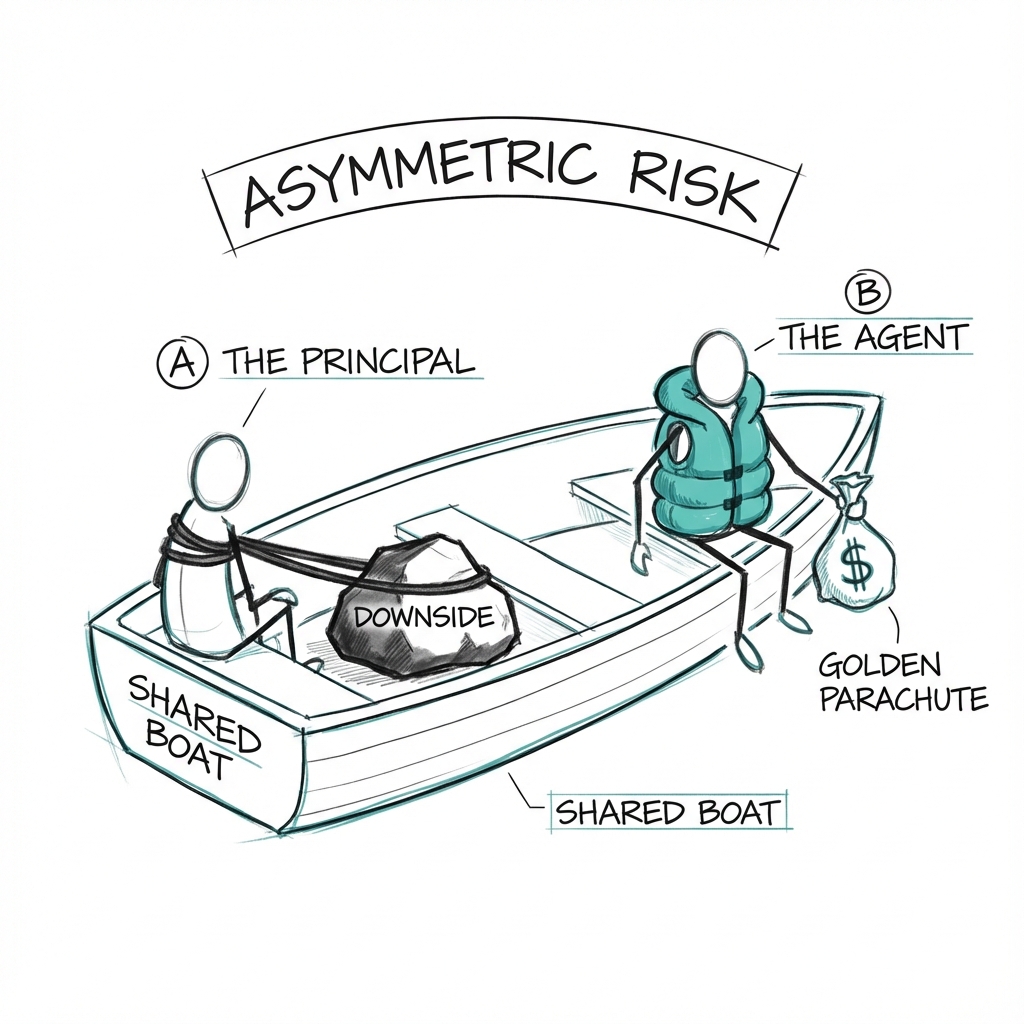
2. The Agency Problem
Economists call this the Agency Problem.
It occurs whenever an agent (someone doing the work) has different interests than the principal (the person affected by the work).
- The Doctor: If a doctor prescribes a statin, he avoids a lawsuit (immediate legal risk) but you might suffer side effects ten years later (long-term health risk). His risk is not your risk.
- The Military Interventionist: If a pundit advocates for regime change in Libya, he gets to appear serious on TV. If Libya descends into a slave-trading chaos (which it did), the pundit loses nothing. He stays in his air-conditioned office.
There is a simple heuristic to navigate this:
Never take advice from someone who doesn't have a penalty for being wrong.
If someone gives you investment advice, don't ask what they think. Ask to see their portfolio. Opinions are cheap. Exposure is real.
3. The Silver Rule
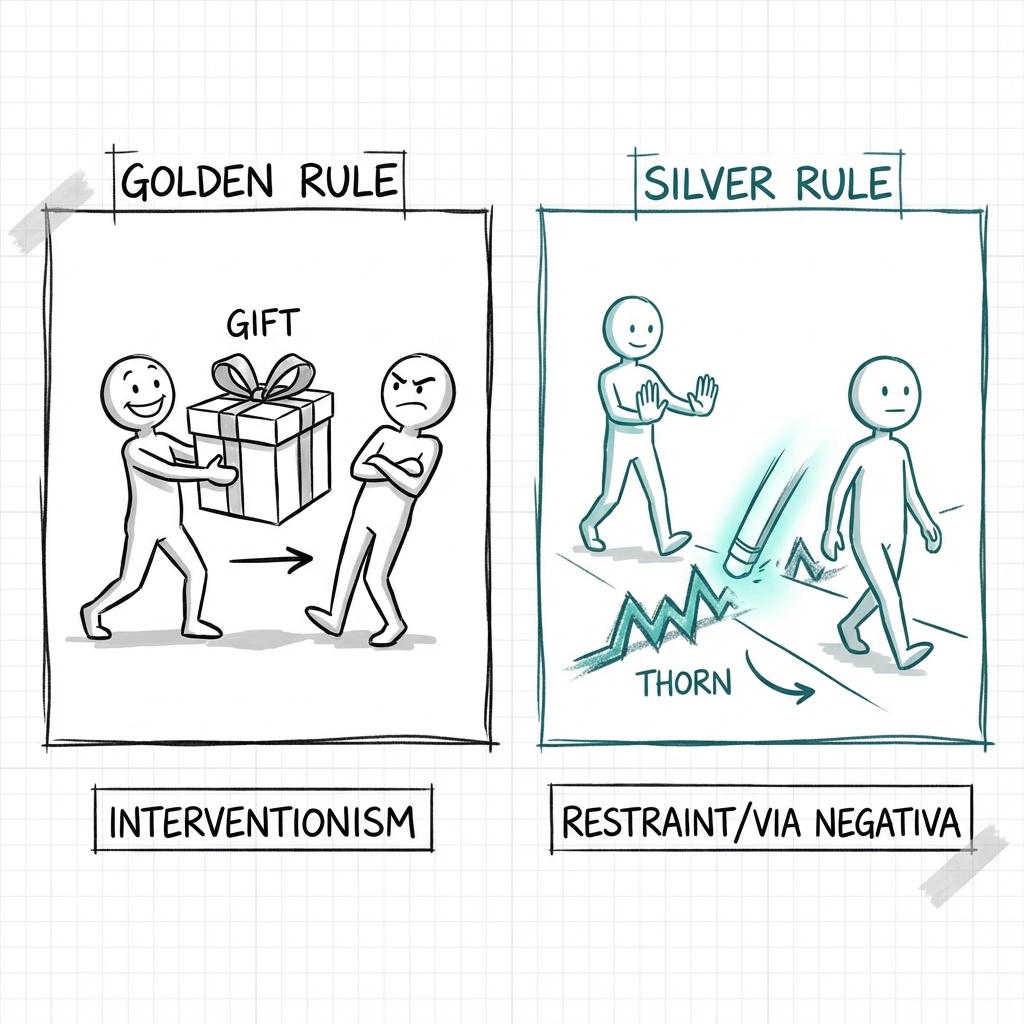
We are raised on the Golden Rule: Treat others the way you would like them to treat you.
Taleb argues this is insufficient and potentially dangerous because it invites you to force your preferences on others. It presumes you know what is good for them.
The more robust alternative is the Silver Rule:
Do not do to others what you would not like them to do to you. — Nassim Nicholas Taleb
This is via negativa: improvement by subtraction. We know with much more certainty what harms people than what helps them.
- Golden Rule: "I should force this democracy on this country because I like democracy." (Interventionism).
- Silver Rule: "I should not bomb this country because I would not like to be bombed." (Restraint).
Symmetry is the essence of justice. It focuses on systemic stability as much as fairness. When decision-makers are insulated from the consequences of their actions, they inevitably engage in reckless behavior that creates systemic ruin.
The only valid leader is the one who leads from the front, taking more risk than his troops, not less.
But symmetry is not just imposed top-down by leaders. It emerges from the bottom up, driven by forces most people never notice.