100,000 years ago, you were food.
If you had been born on the African savanna, your primary goal each day would have been simple: avoid being eaten.
You were not at the top of the food chain. You were somewhere in the middle. Lions hunted you. Hyenas scavenged your kills. Eagles occasionally snatched your babies.
You had a big brain, but that was more of a liability than an asset. It consumed enormous amounts of energy and forced your children to be born helpless. You could make a few stone tools, but so could your cousins, the Neanderthals, who were physically stronger than you in every way.
There was nothing about you that would suggest world domination.
Today, your species controls the fate of every animal on the planet. You have split the atom. You have walked on the moon. You are one button-press away from ending most complex life on Earth.
What happened?
Yuval Noah Harari suggests the answer is unexpected.
We rose to dominance about 70,000 years ago because we learned a skill no other animal possesses: the ability to believe in things that do not exist. Strength and speed were never our greatest assets. Cooperation was.
It is the story of how an animal of no significance came to dominate the entire planet. We will explore the three revolutions that define our history:
- The Cognitive Revolution, which gave us fiction.
- The Agricultural Revolution, which trapped us in a life of hard labor.
- The Scientific Revolution, which gave us the power to end our own story.
By the end, you will discover:
- Why you can trust a stranger only if you both believe in the same imaginary story.
- Why the Agricultural Revolution was actually history's most successful swindle.
- How a single accidental mutation turned Sapiens into the planet's most dangerous ecological force.
- Why money is the most tolerant and successful religion ever devised.
- Why your biochemical baseline means you aren't significantly happier than a hunter-gatherer.
- How we are currently replacing 4 billion years of natural selection with our own design.
The 1-Minute Summary
The history of humankind is defined by three revolutions:
- The Cognitive Revolution (70,000 years ago) gave us the ability to believe in fictions.
- The Agricultural Revolution (12,000 years ago) let us multiply but trapped us in harder labor.
- The Scientific Revolution (500 years ago) gave us the power to end our own history.
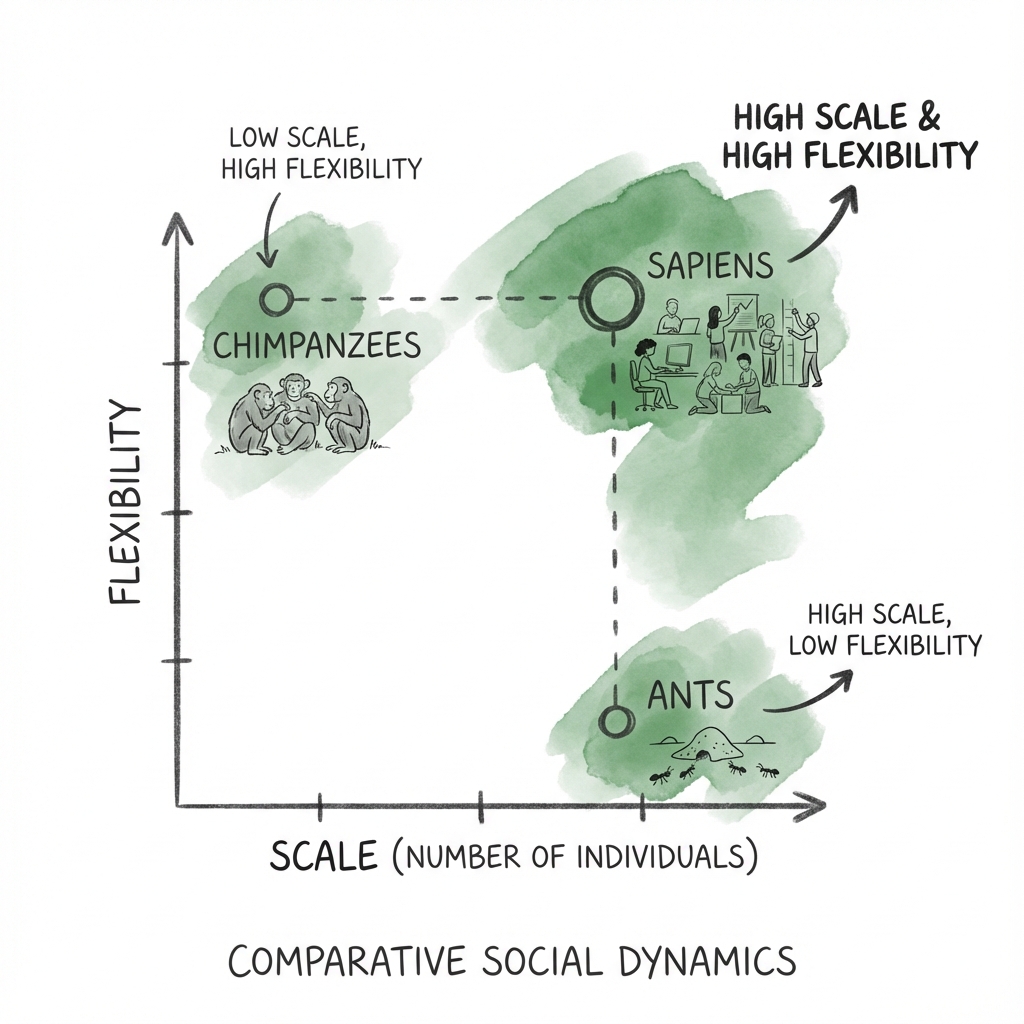
Sapiens rule the world because we can cooperate flexibly in large numbers. No other animal can do this. Ants cooperate in millions, but they are rigid. Chimpanzees are flexible, but only in small groups.
Our secret weapon is the Imagined Order.
We are the only species that can believe in things that exist purely in our shared imagination. Money, nations, and human rights are not biological realities. They are shared myths.
This imagined reality is the most powerful force on the planet. It allows millions of strangers to work toward a common goal.
Module 1
The Cognitive Revolution
For most of our history, humans were not the masters of their domain.
We were mid-sized apes, scurrying through the undergrowth of East Africa. We lived in constant fear of predators and spent most of our time digging up roots, picking berries, and chasing down insects.
We were, in Harari's words, an animal of no significance.
We used to think of ourselves as the only humans. But for at least 2 million years, several human species walked the earth at the same time.
There were the bulky Neanderthals in Europe. There was Homo erectus in Asia, the most durable human species to ever live. There were even dwarves on the island of Flores.
The story of Homo sapiens becoming the last human species standing is a story of mental adaptation, far more than physical power. A Neanderthal could have crushed a Sapiens physically, but our secret weapon was our brain. Having such a large brain, however, came with a massive price tag.
1. The Cost of Thinking
A jumbo brain is a jumbo drain on the body.
In Sapiens, the brain accounts for about 2–3 percent of total body weight. Yet it consumes 25 percent of the body's energy when at rest.
To fuel this, our ancestors had to spend more time searching for food. Our muscles shrank.
We traded biceps for neurons.
Another trade-off was walking upright. Standing on two legs freed our hands for tools, but it narrowed the hips of women.
This made childbirth dangerous.
Evolution favored earlier births, before the baby's head got too big. This means humans are born prematurely compared to other animals.
A colt can trot shortly after birth. A human baby is helpless for years.
This biological reality forced us to become social. You cannot raise a human child alone. It takes a tribe.
2. The Tree of Knowledge
About 70,000 years ago, something changed.
Sapiens began to invent boats, oil lamps, and bows and arrows. They started creating art and practicing religion.
Harari calls this the Cognitive Revolution.
Most researchers believe an accidental genetic mutation changed the inner wiring of our brains. This Tree of Knowledge mutation enabled us to communicate using a new type of language.
Every animal has a language. Bees dance to show the way to food. Green monkeys have specific calls for lion or eagle.
But Sapiens language is uniquely supple. We can produce an infinite number of sentences with distinct meanings.
This allowed us to share two specific types of information that changed everything:
- Gossip: Our language evolved as a way to talk behind each other's backs. Knowing who in the tribe could be trusted and who was a cheat allowed us to expand our groups.
- Fiction: This is the most important feature. Sapiens are the only species that can talk about things that do not exist.
You can never convince a monkey to give you a banana by promising him limitless bananas in monkey heaven.
But Sapiens can.
This ability to speak about fictions allowed us to imagine things collectively. We could weave common myths.
3. The Power of Imagined Realities
Fiction enabled us not merely to imagine things, but to do so together.
Common myths give Sapiens the unprecedented ability to cooperate flexibly in large numbers.
Sociology shows that the natural size of a group bonded by gossip is about 150 individuals.
Most people cannot intimately know more than 150 people. Once a group crosses this threshold, it usually destabilizes and splits.
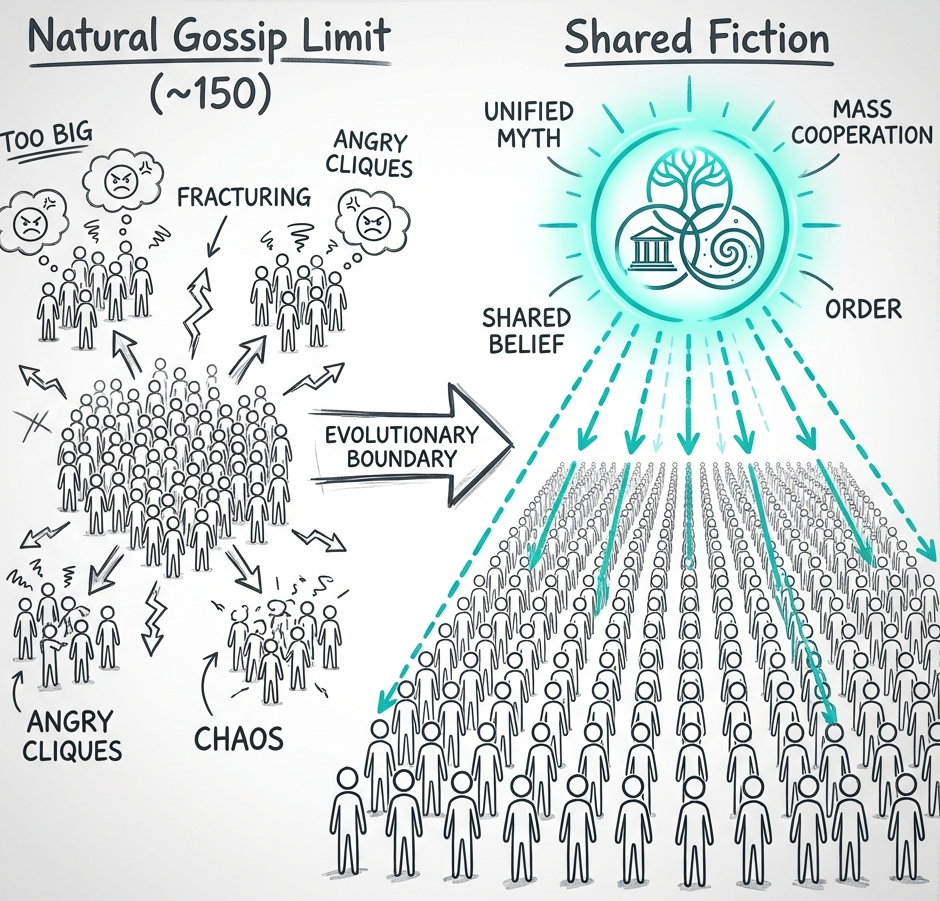
How did Sapiens manage to found cities of tens of thousands and empires of millions?
The secret was the appearance of fiction.
Large numbers of strangers can cooperate successfully if they believe in common myths.
Any large-scale human cooperation is rooted in an imagined reality: modern states, medieval churches, ancient cities.
These are things that exist only in our shared imagination. There are no gods, no nations, and no money outside the stories we tell each other.
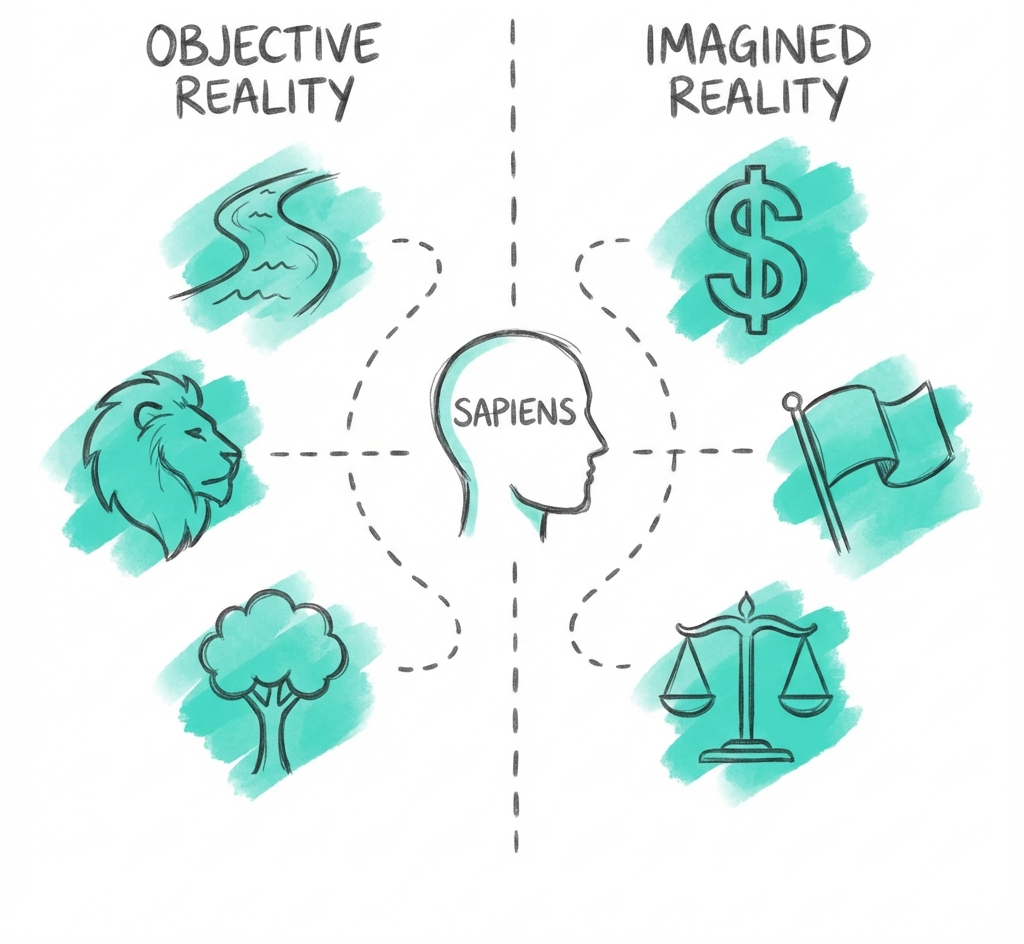
Once the Cognitive Revolution happened, Sapiens no longer lived only in the objective reality of rivers and lions.
We started living in a dual reality.
4. The Ecological Serial Killer
Equipped with this new ability to cooperate, Sapiens began to overrun the planet.
And wherever we went, we brought death.
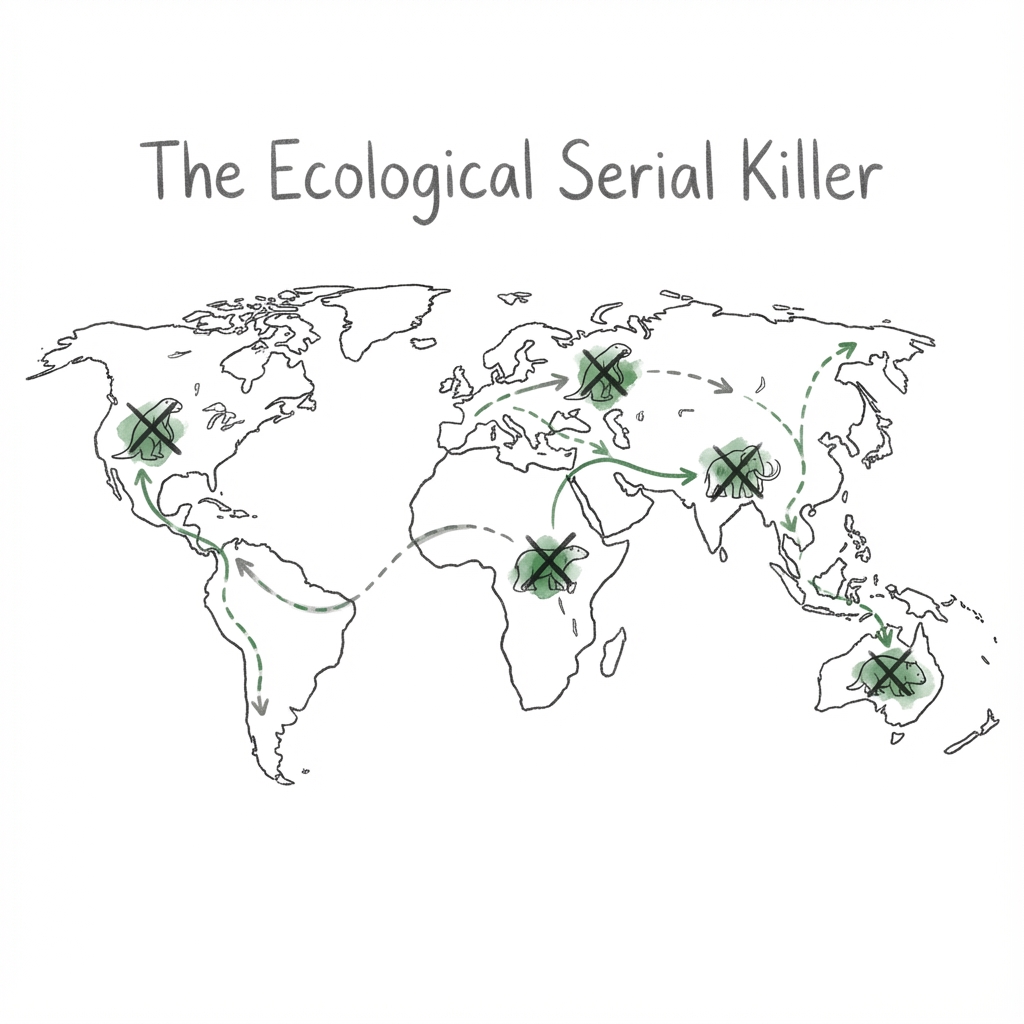
About 45,000 years ago, Sapiens reached Australia. Within a few thousand years, 23 out of the 24 animal species weighing 100 pounds or more were extinct.
The giant diprotodon (a two-and-a-half-ton wombat) vanished, along with the marsupial lion and six-foot kangaroos.
A similar disaster occurred in America 16,000 years ago. Within 2,000 years of Sapiens' arrival, North America lost 34 out of its 47 genera of large mammals.
The mammoths, the giant ground sloths, and the sabre-tooth cats were all wiped out.
The historical record makes Homo sapiens look like an ecological serial killer.
We did not live in harmony with nature. Long before the Industrial Revolution, we held the record for driving the most species to extinction.
We were the most destructive force the animal kingdom had ever produced.
This mastery over the animal world set the stage for the next great transformation. Having cleared the land of giant beasts, Sapiens began to settle down.
But as we would soon find out, the decision to stop wandering was a trap.