Toward the end of April 1519, the Château of Cloux in France was quiet.
In a large bed, Leonardo da Vinci, the man whom King François I called the living embodiment of the Renaissance, was dying.
The King sat by his bedside, perhaps expecting final words on the Mona Lisa or the secrets of painting. But the sixty-seven-year-old artist wasn't thinking about his fame. He was thinking about a white iris.
He was thinking back to his childhood in the village of Vinci, where he used to steal paper from his father’s office to sketch in the wild forests.
He remembered staring at that iris, obsessed with a single question.
What is the force that pushes this flower to grow, to unfold through specific stages, and to bloom into this unique shape?
Leonardo believed there was a hidden force within all living things.
A destiny encoded in the seed that drives it to fulfill its potential.
He saw his life as a submission to this force rather than a mere series of accidents.
It compelled him to dissect corpses to understand the human form.
It drove him to design flying machines when others saw only madness.
Robert Greene believes this force is a biological fact, far more than a mystical gift reserved for the divine.
Your DNA, combined with your specific neurochemistry, has never occurred before and will never occur again.
In childhood, you felt this pull clearly.
You were drawn to specific activities, subjects, or questions.
You didn't ask why you liked them. You just did.
But then, the counterforce arrived.
Parents told you to be practical. Teachers told you to fit in. Peers pressured you to conform. The noise of the world drowned out the signal from your own biology.
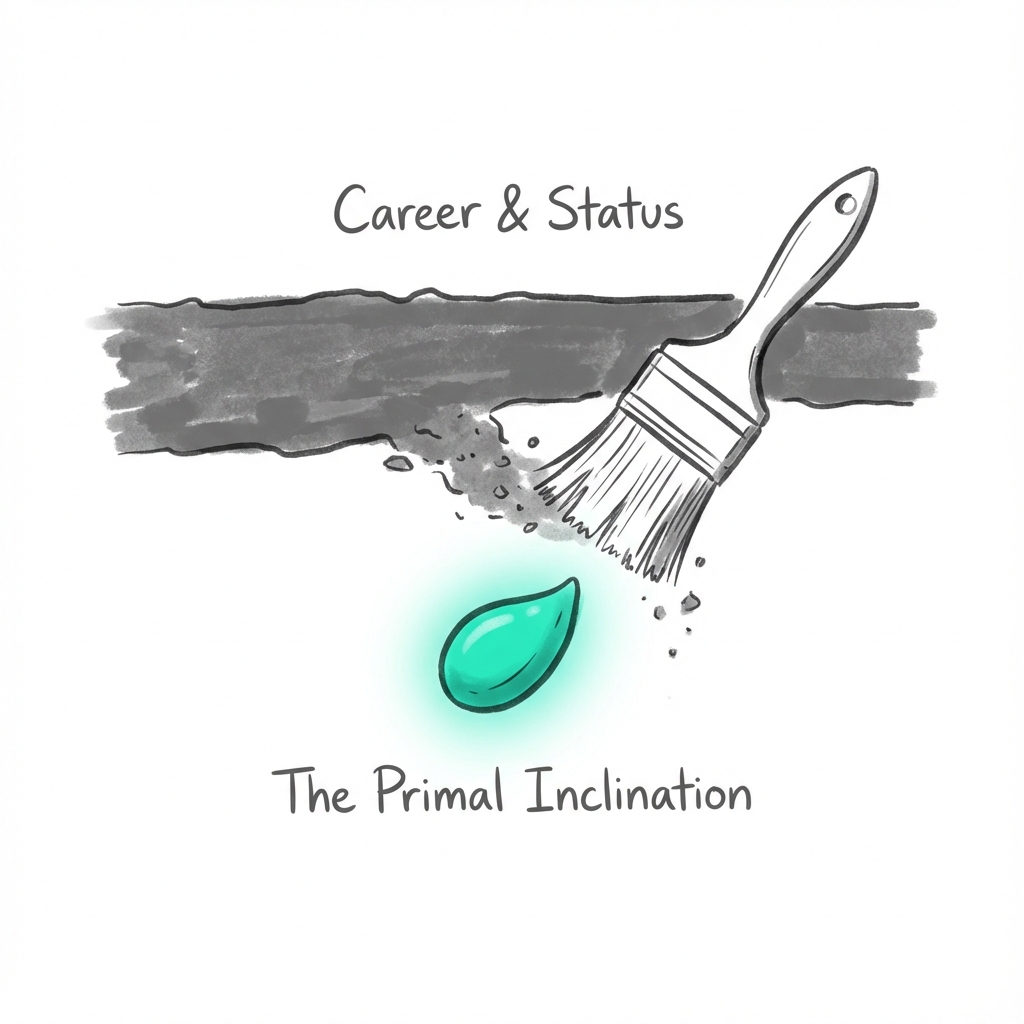
You drifted into a career for money or status rather than fit.
You became fragmented, passive, and bitter.
This longform explores how to overcome that passivity by understanding the process of mastery. It encourages a shift away from the idea that genius is purely genetic, revealing it instead as a predictable way of engaging with the world that transforms the human brain.
Mastery is working with the grain of your own evolution to recover the power that was yours at birth.
What follows is a map of that process.
By the end, you will discover:
- Why your childhood obsessions hold the key to your future career.
- Why the most effective apprenticeship involves five years of "useless" work.
- Why you can absorb decades of knowledge by mirroring a mentor's brain.
- Why treating difficult people like "facts of nature" is your greatest creative defense.
- Why the most brilliant breakthroughs happen only after you stop trying.
- Why mastery turns your logic into high-speed intuition.
The 1-Minute Summary
Mastery comes from deep focus and time, regardless of innate genius or talent.
It is a biological potential inherent in every human brain. It is accessible to anyone willing to follow a rigorous process of learning and experimentation.
The Arc of Mastery
- Discover Your Calling. You must first reconnect with your Life's Task. The primal curiosity you felt before social conditioning took over. This provides the emotional fuel to survive the hard work ahead.
- The Apprenticeship. You submit to reality. You observe the rules of your field, acquire tacit knowledge through tedious practice (10,000 hours), and find mentors to accelerate your learning.
- The Creative-Active. You move from student to practitioner. You begin to combine ideas from different fields, break the rules you mastered, and develop your own style.
- Mastery. After years of immersion, the skill becomes internalized. You fuse the rational with the intuitive, gaining a fingertip feel for your field that allows you to see the whole picture and make rapid, accurate decisions.
The only true failure is to ignore the call of your own potential. By following your natural inclinations, you do not just succeed. You fulfill your evolutionary purpose.
Module 1
Discover Your Calling (The Life’s Task)
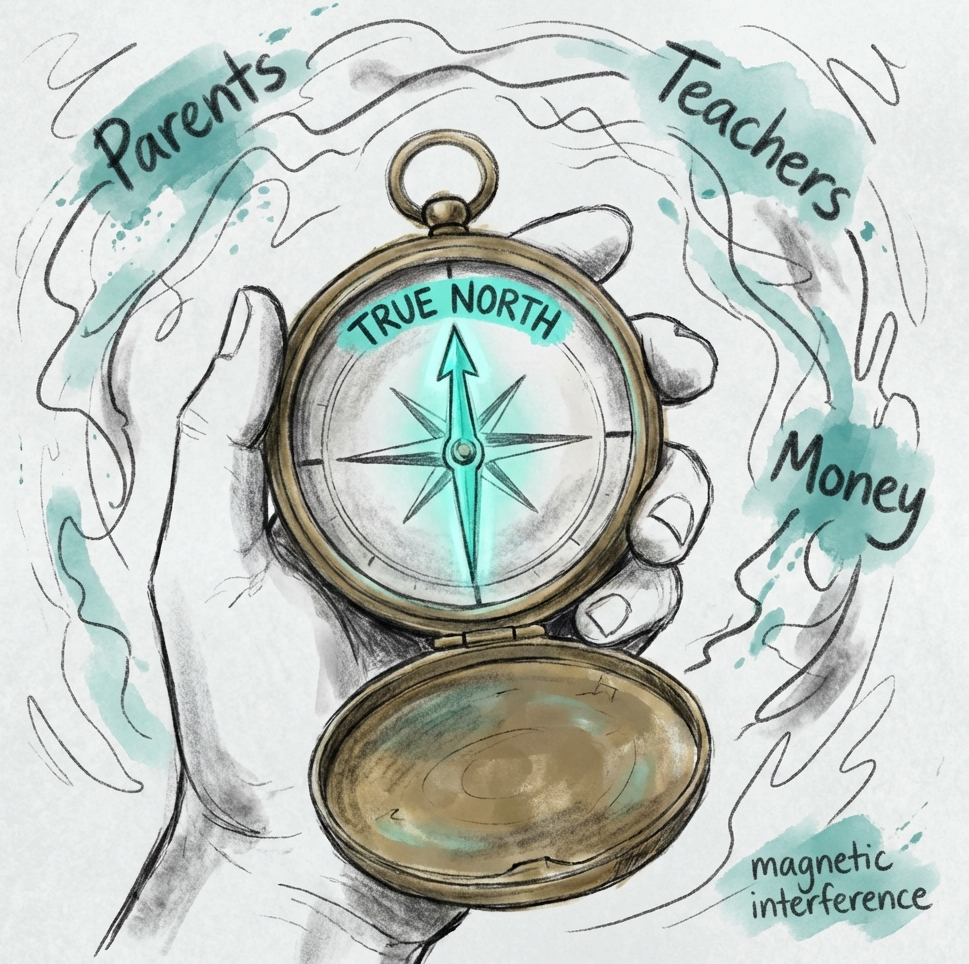
The boy held the cold brass instrument in his small hand. He shook it. He turned it upside down. He ran in circles. No matter what he did, the magnetic needle ignored him. It pointed north, guided by an invisible force he couldn't see, touch, or explain.
For most children, the compass would have been a toy.
For Einstein, it was a terror and a wonder.
It told him that there was something behind things.
Something deeply hidden.
He trembled with the intensity of the feeling.
That trembling is the signal.
Robert Greene calls this The Primal Inclination.
It is the first sign of your Life's Task.
It is more of a physical reaction than an intellectual decision.
A voice from your DNA speaking through your nervous system.
We all hear it.
The problem is not that the voice is silent.
The problem is that we stop listening.
1. The Voice and the Noise
As children, we are naturally drawn to things.
- One kid is obsessed with rocks.
- Another with the sound of words.
- Another with the way a machine clicks together.
But then, the Counterforce begins its work.
It starts with well-meaning parents. "You can't make money collecting rocks," they say. "Engineering is a safer bet." Then come the teachers, the peers, the culture. They smooth out your rough edges. They tell you that your obsession is weird, or useless, or antisocial.
So you bury it.
You choose a career based on what is lucrative, or what your friends are doing.
You drift.
You separate your life from your work.
You live for the weekend, while your work hours (the majority of your waking life) become a dead zone.
You risk becoming disconnected from who you actually are.
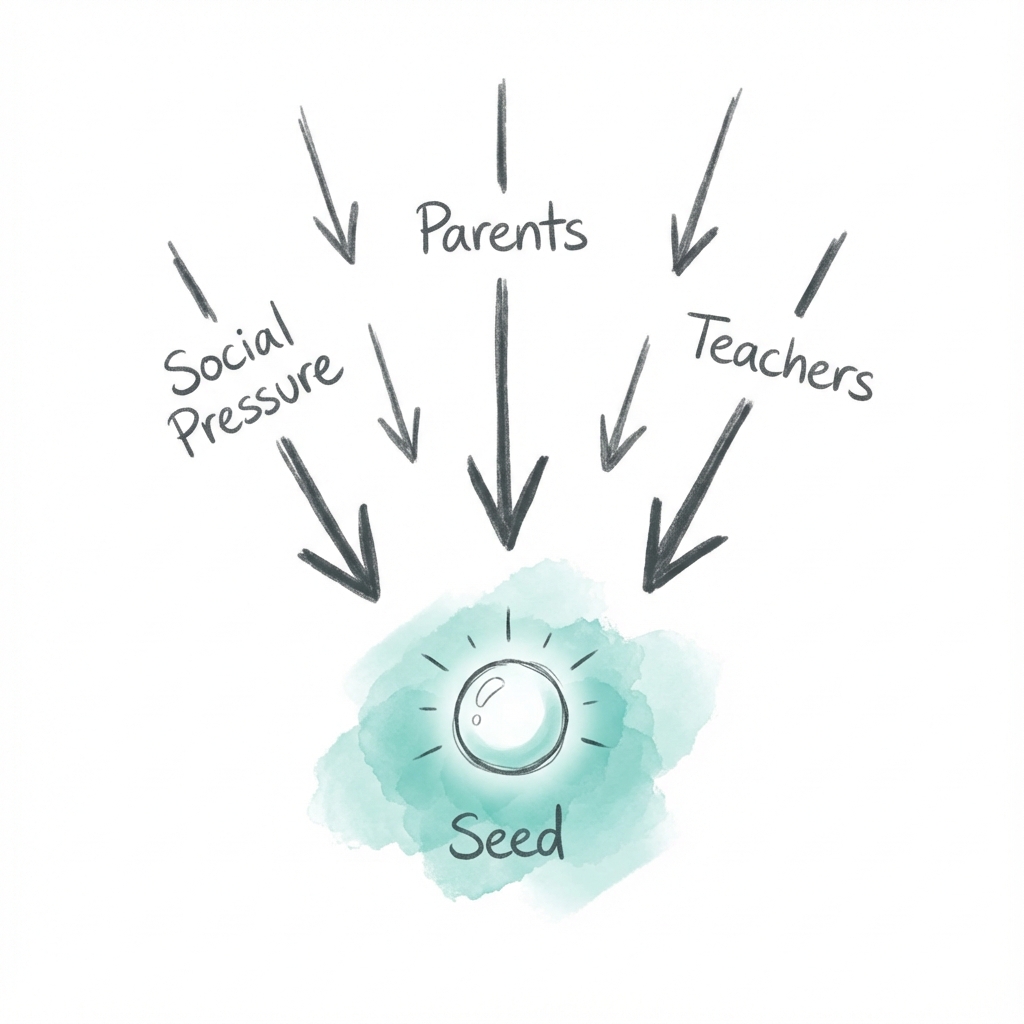
But the voice doesn't die. It just goes underground.
It manifests as boredom. It manifests as a low-grade depression.
It manifests as the feeling, late on a Sunday night, that you are wasting your life.
Greene’s strategy is simple but radical.
You must reconnect with your childhood obsession and bring it back into focus.
2. Return to Origins
How do you find a signal that was buried twenty years ago?
You perform an archeological dig.
You don't look for a specific job title (like an accountant). You look for a sensation.
- Einstein didn't want to be a physicist. He wanted to understand hidden forces. Physics was just the best vessel for that obsession.
- John Coltrane didn't want to play jazz. He felt a spiritual longing he couldn't speak. When he heard Charlie Parker play the saxophone, he realized the instrument could let him speak without words. The saxophone became his bridge to the divine.
This pattern isn't just for geniuses. It is the fundamental logic of survival.
Ask yourself:
- What did I do as a child that made me lose track of time?
- What subjects stimulate a visceral curiosity in me, not just an intellectual one?
- What activity gives me a feeling of power?
Strip away the career. Look for the underlying pattern.
If you loved strategy games, the pattern isn't gaming. It is high-level problem solving.
If you loved arguing, the pattern isn't being difficult. It is rhetoric and persuasion.
Find the pattern, and you find the seed of your Life’s Task.
3. Occupy the Perfect Niche (The Darwinian Strategy)
In nature, animals survive by finding a niche where they don't have to compete directly with everyone else.
A finch with a specific beak shape can eat seeds other birds can't crack.
The human career world is an ecosystem.
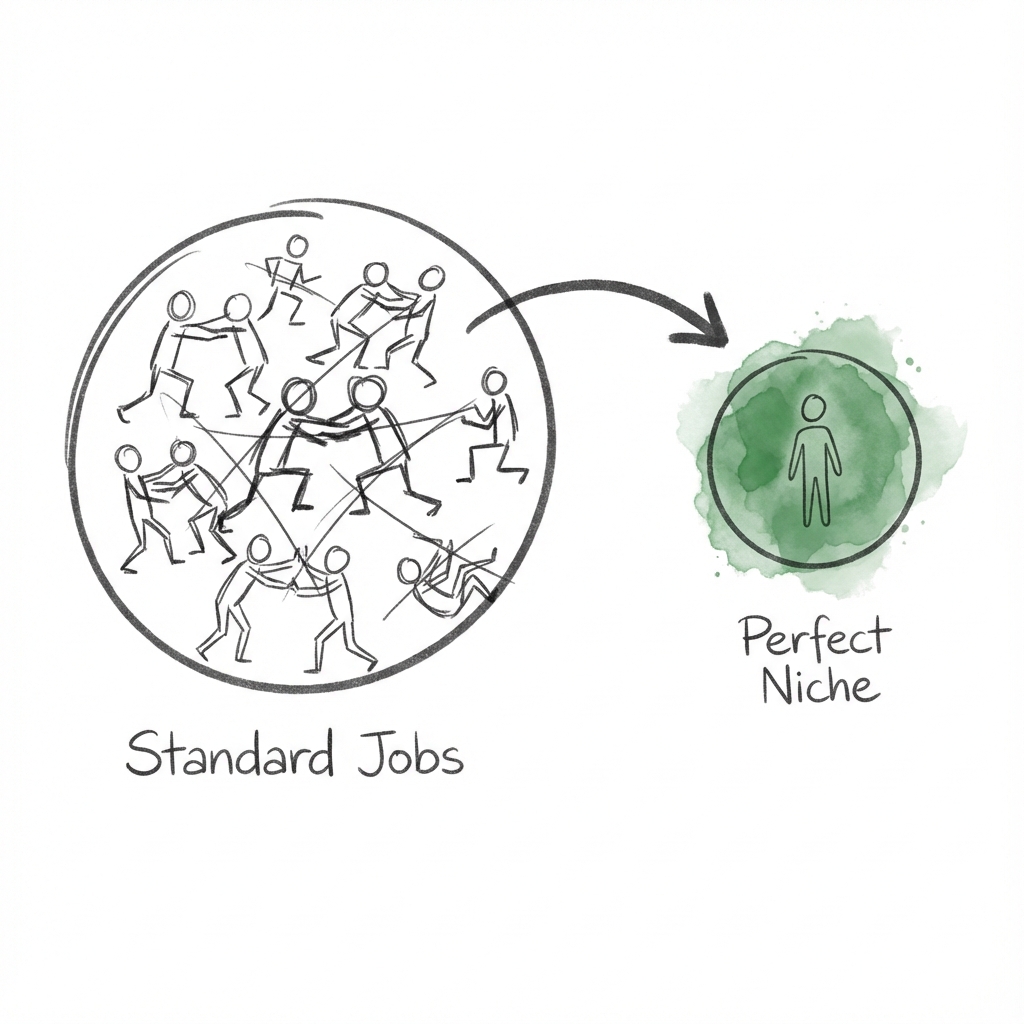
Most people crowd into the same few niches.
They compete for the same standard jobs, fighting over scraps.
It is a fierce, exhausting war.
The Master refuses to compete.
The Master creates a monopoly of one.
V.S. Ramachandran was a strange boy who loved collecting sea shells. He loved anomalies. Nature's freaks. His father pushed him into medicine. He hated the rote memorization. Instead of quitting, he merged his obsession with his duty. He went into visual psychology, but he focused on the weird stuff (optical illusions and phantom limbs). He studied the things other scientists ignored as freaks.
By combining his medical training with his obsession for anomalies, he created a new field.
Behavioral neurology.
He didn't have to compete with other neurologists because no one else was doing what he was doing.
Don't just pick a field.
Pick a field, then drill down into a specific, neglected corner of it that matches your unique interests.
If that corner doesn't exist, create it.
4. Avoid the False Path (The Rebellion Strategy)
The greatest danger to your Life’s Task is success in the wrong field.
If you are competent at something you hate, the world will reward you for it. They will give you money. They will give you praise. They will lock you in a golden cage.
Wolfgang Amadeus Mozart was a child prodigy, paraded around Europe by his father like a circus animal.
He was forced to play safe, conventional music for court patrons. He was successful. He was famous. And he was suffocating.
At twenty-five, he snapped. He quit his job with the Archbishop of Salzburg. He even got kicked in the rear end by the Archbishop’s secretary on the way out. He moved to Vienna. He stopped writing music to please patrons and started writing the music he heard in his head. Complex, dark, challenging operas like Don Giovanni. He struggled financially. He alienated people. But he became Mozart.
If you are on a False Path, you will feel it.
Your work will feel heavy.
You will be cynical.
You will need endless entertainment to distract you from the emptiness.
Rebellion is a necessary survival strategy for your career, far more than just a passing teenage phase. You must have the courage to disappoint your parents, your friends, and your bank account in the short term, to save your life in the long term.
Your Life’s Task is to bring that seed to flower. You have a destiny to fulfill. — Robert Greene
Once you have reclaimed this seed, the work of transformation truly begins. You must now leave the world of dreams and prepare to enter the arena of practical struggle.