Consider the mother turkey. She is a good mother. She is watchful and protective. She spends her life tending to her young, warming them, cleaning them, huddling them beneath her feathers.
But there is something odd about her method.
Almost all of this mothering is triggered by one thing.
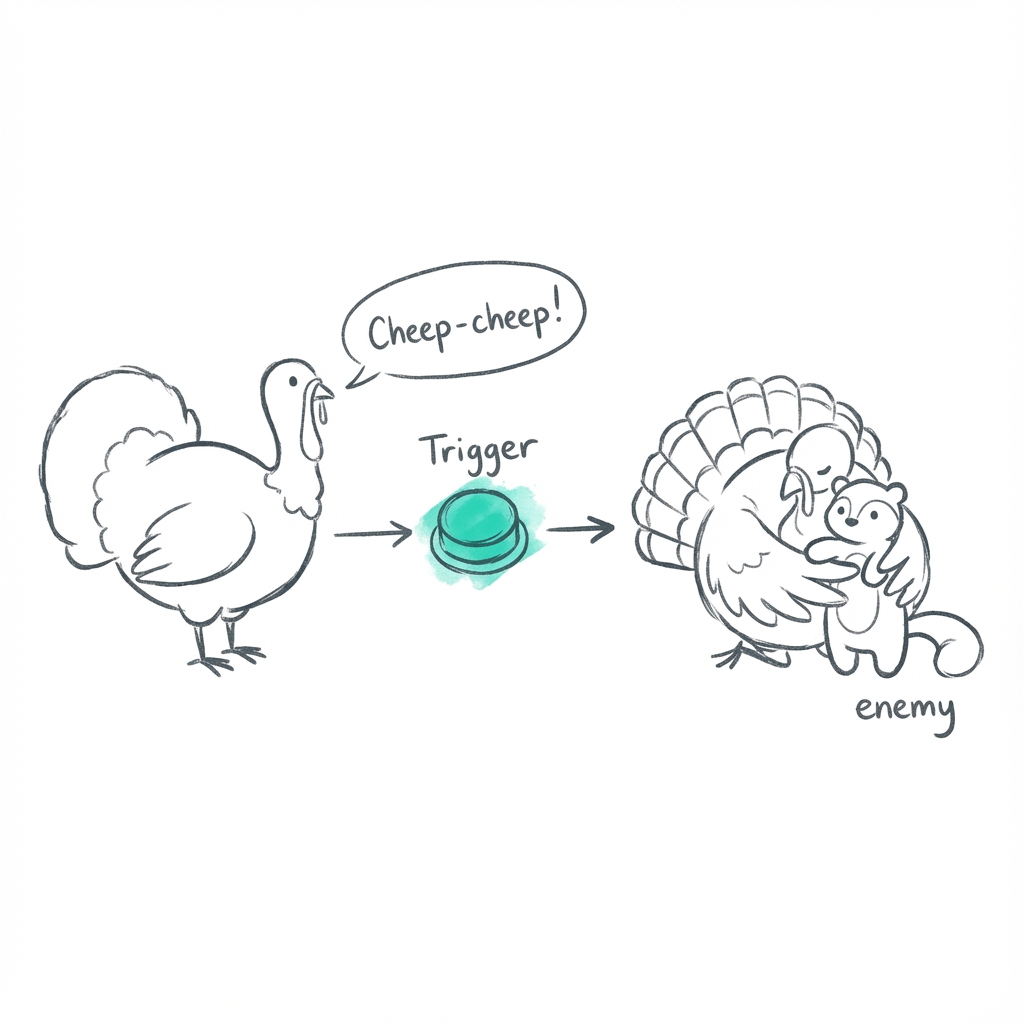
The specific cheep-cheep sound of young turkey chicks.
If a chick makes the noise, the mother cares for it.
If it doesn't, she ignores it or even kills it.
Animal behaviorist M.W. Fox proved this with a strange experiment.
He placed a stuffed polecat (a natural enemy of turkeys) near a mother turkey. She attacked it with squawking rage. Then he hid a small recorder inside the polecat. It played the cheep-cheep sound of baby turkeys. The mother stopped attacking. She gathered the enemy underneath her feathers. When the machine was turned off, she attacked again.
It looks ridiculous.
She embraces a mortal enemy just because it goes cheep-cheep.
Her instincts are under the control of a single sound.
Ethologists call these fixed-action patterns.
Automatic sequences of behavior triggered by a specific cue.
Click the trigger, and whirr. The behavior rolls out.
It is easy to feel smug about the turkey. We aren't that simple.
Or are we?
Social psychologist Ellen Langer tested this.
She asked people waiting in line for a copy machine: "Excuse me, I have five pages. May I use the Xerox machine because I'm in a rush?"
94% let her skip ahead.
Then she removed the reason: "Excuse me, I have five pages. May I use the Xerox machine?"
Only 60% complied.
The difference seems to be the information "because I'm in a rush."
But Langer tried a third version: "Excuse me, I have five pages. May I use the Xerox machine because I have to make some copies?"
93% agreed.
She gave no real reason. Everyone in line had to make copies. But the word because triggered an automatic compliance response.
Click, whirr.
We don't act this way because we are stupid. We act this way because we have to. We live in the most rapidly moving and complex environment that has ever existed on this planet.
To deal with it, we need shortcuts.
We cannot analyze every aspect of every person, event, and situation we encounter in a single day. We don't have the time, energy, or capacity.
So we use stereotypes and rules of thumb.
We classify things by a few key features and respond mindlessly when one of those trigger features is present.
- Expensive = Good
- Expert = Truth
- Rare = Valuable
Civilization advances by extending the number of operations we can perform without thinking about them. But this efficiency comes at a cost. It makes us terribly vulnerable to anyone who knows how the tapes work.
There are people who know where the buttons are.
They go from social encounter to social encounter, requesting compliance and getting it, often with dazzling success.
They are called compliance professionals. These include:
- Salespeople.
- Fund-raisers.
- Recruiters.
- Advertisers.
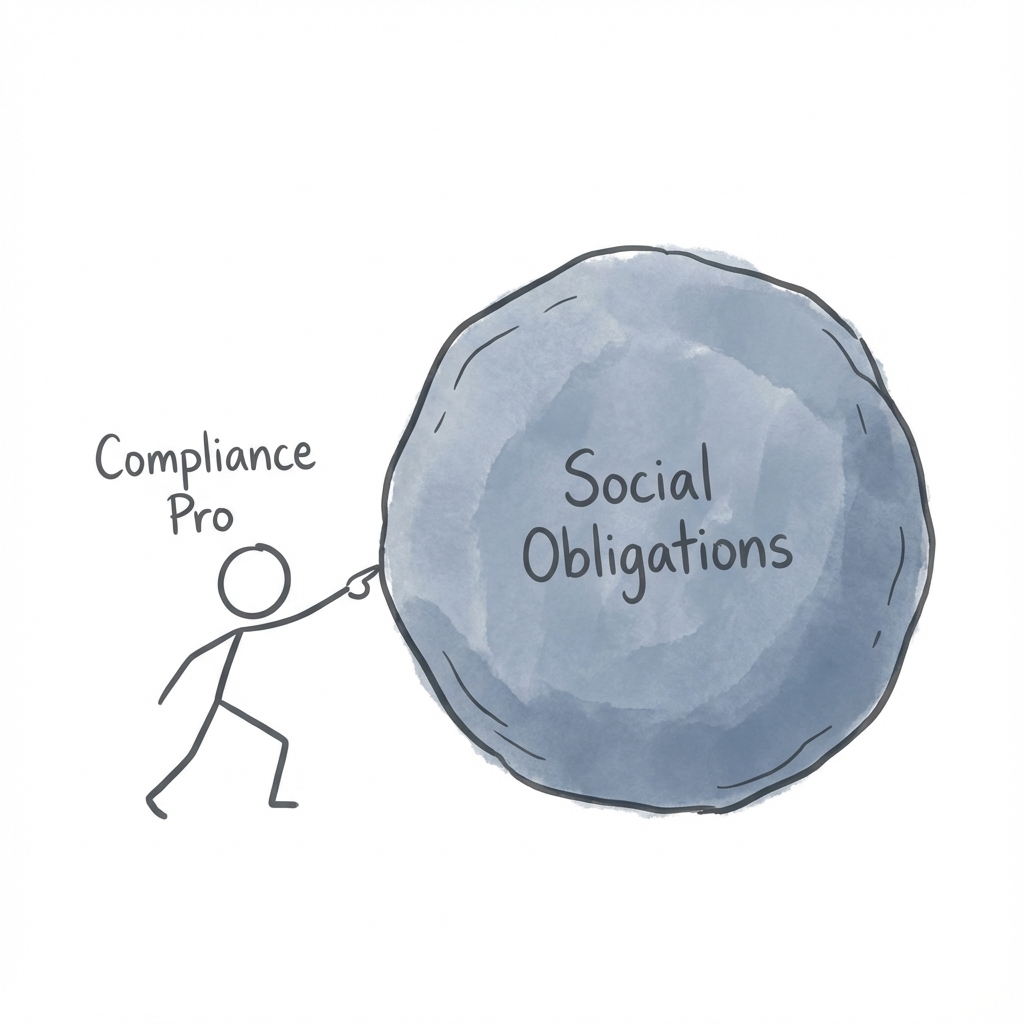
They don't need to use force. They use jujitsu.
In the Japanese martial art, you use your opponent's own strength against them. You exploit gravity, leverage, and momentum.
Compliance professionals do the same.
They tap into the massive power of social obligation or consistency that already exists within us and align it with their goals.
Robert Cialdini, a social psychologist, spent three years going undercover.
He trained as a car salesman, a fund-raiser, and a telemarketer.
He studied the tactics from the inside.
What he discovered is that virtually all compliance tactics fall into six basic categories. He calls them the weapons of influence.
Each weapon exploits a different psychological principle.
Each one can be used ethically or exploited by those who want your money, your vote, or your time.
Each one operates mostly below conscious awareness.
This longform will walk you through all six weapons of influence.
By the end, you will discover:
- Why a "free" sample almost always costs you more than you realize.
- Why a tiny commitment today makes you vulnerable to a massive request tomorrow.
- Why we follow the crowd, even when the crowd is walking off a cliff.
- Why you buy from people you like, even when their product is worse.
- Why a lab coat can make ordinary people do terrible things.
- Why we pay more for things that are running out, even when we don't need them.
The 1-Minute Summary
We like to think we are rational decision-makers, but the complexity of modern life forces us to rely on mental shortcuts. These are fixed-action patterns.
Like a mother turkey that nurtures a stuffed enemy because it makes a specific sound, we respond automatically to specific social triggers.
The 6 Weapons of Influence
- Reciprocation: The overpowering rule that forces us to repay debts, even uninvited ones.
- Commitment & Consistency: The obsessive desire to appear consistent with what we have already done or said.
- Social Proof: The tendency to view a behavior as correct if we see others doing it.
- Liking: The rule that we say "yes" to people we know and like.
- Authority: Our deep-seated duty to obey instructions from those in charge.
- Scarcity: The way opportunities seem more valuable to us when their availability is limited.
Knowledge is our only defense. By recognizing these triggers, we can spot when they are being counterfeited by compliance professionals and step out of the automatic click, whirr response.
Module 1
Reciprocation: The Old Give and Take
In 1985, Ethiopia was in ruins.
Its economy was decimated, its food supply ravaged by drought, and its people were dying by the thousands from starvation and war. Yet, that same year, the Ethiopian Red Cross sent $5,000 to aid the victims of the earthquakes in Mexico City.
Why would a country in such desperate need send money to another?
The answer is simple and terrifyingly powerful.
In 1935, when Ethiopia was invaded by Italy, Mexico had sent aid. Fifty years later, against all self-interest, the obligation triumphed.
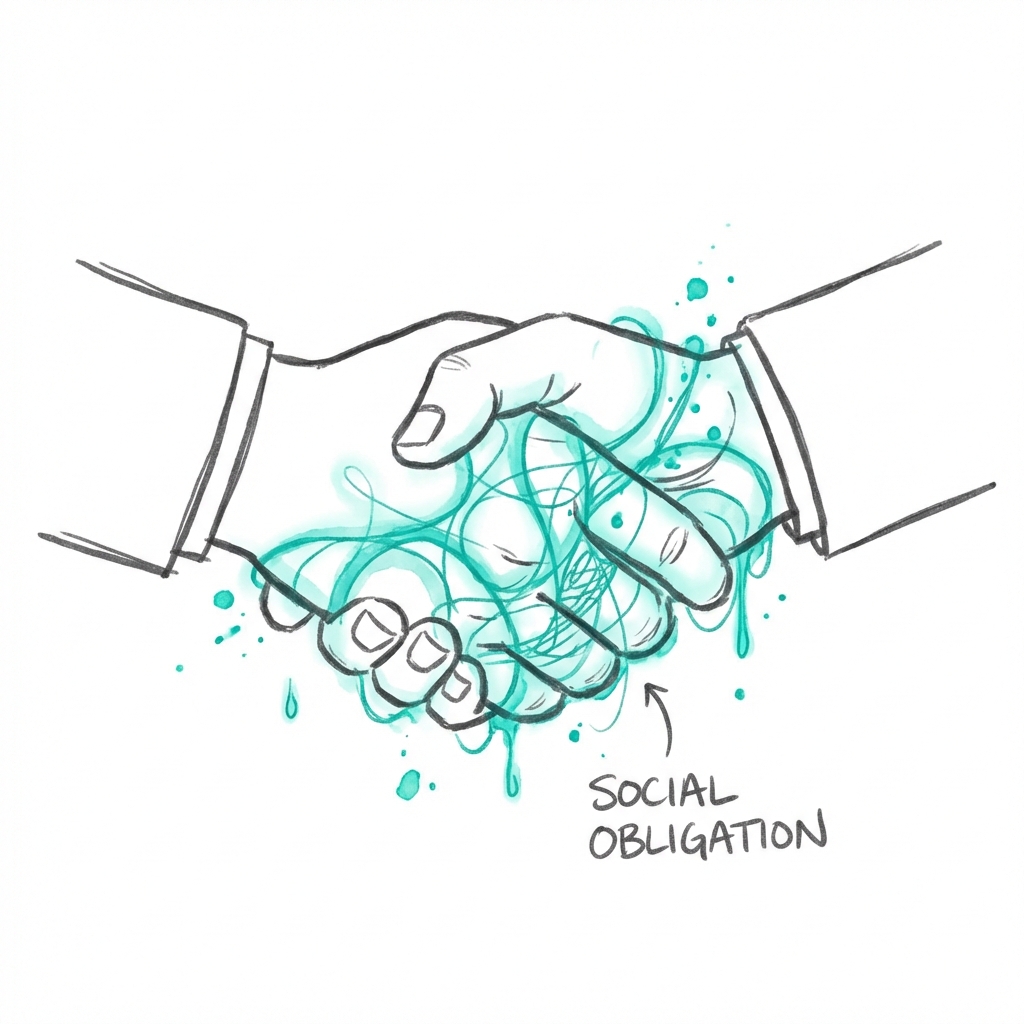
This is the Rule for Reciprocation.
It says that we should try to repay, in kind, what another person has provided us.
We are human because our ancestors learned to share food and skills in an honored network of obligation.
This web of indebtedness is unique to our species. It allowed for the division of labor and the creation of interdependencies that bind us together.
But because it is so vital to society, we are trained from childhood to chafe under the burden of debt. We label those who don't pay back as moochers or ingrates. To avoid those labels, we will go to great lengths. And that is where we get into trouble.
The rule is so strong that it can overwhelm other factors that normally determine compliance, such as whether we like the person making the request.
In a study by Dennis Regan, a subject was joined by an assistant, Joe.
In one scenario, Joe did a small, uninvited favor. He left the room and came back with two Cokes. One for him, one for the subject. In the other scenario, he came back empty-handed.
Later, Joe asked the subjects to buy raffle tickets. The subjects who received the Coke bought twice as many tickets.
For those who owed him a favor, it made no difference whether they liked Joe or not. They felt an obligation to repay him, and they did.
The rule does not require us to have asked for the favor to feel obligated.
The Hare Krishna Society used this loophole to make a fortune in the 1970s. Their chanting and robes made them unpopular with the American public, so soliciting donations was difficult.
They switched tactics.
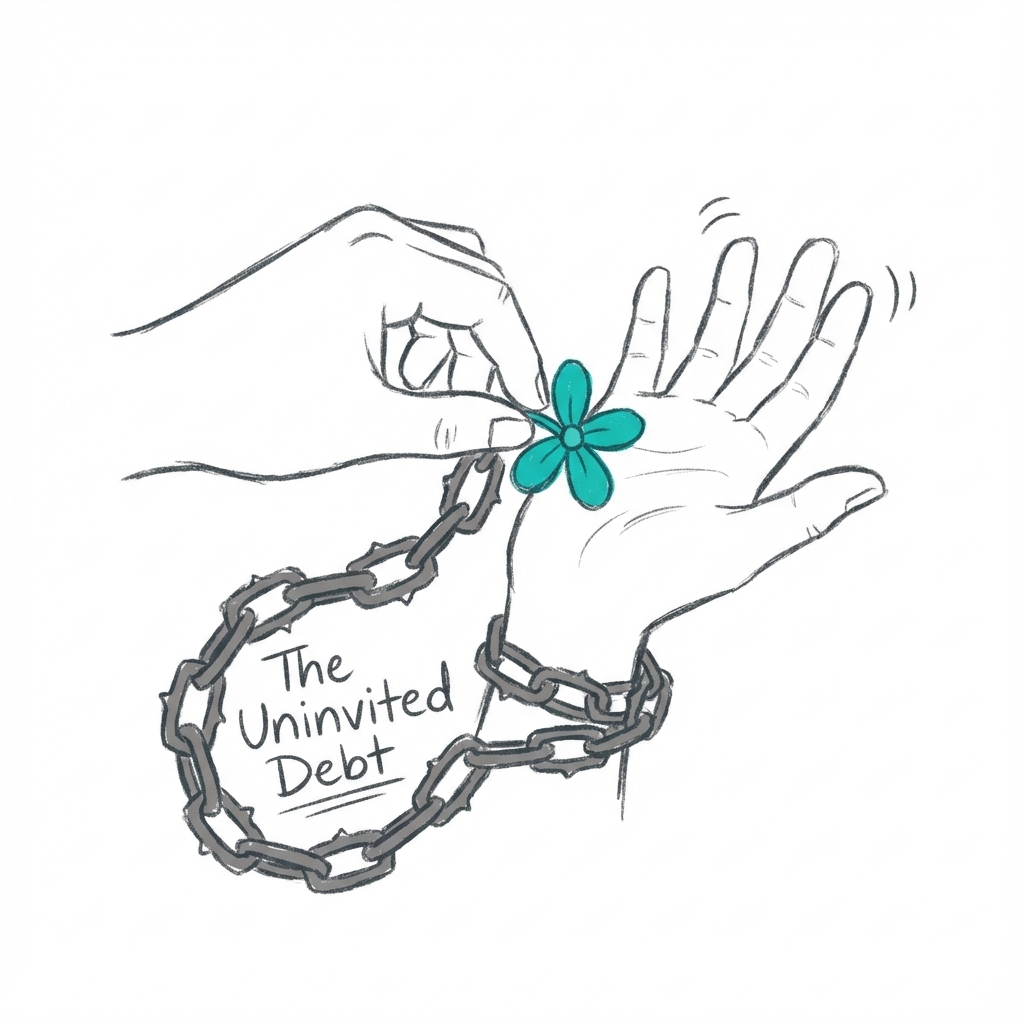
They moved to airports and started pressing gifts into the hands of travelers: a flower or a book. When the traveler tried to give it back, the Krishna member would refuse: "No, it is our gift to you."
Only after the force of the reciprocity rule was locked in did they ask for a donation.
The traveler, now holding an unwanted flower and trapped by a cultural force they couldn't see, would often hand over a dollar just to escape the tension.
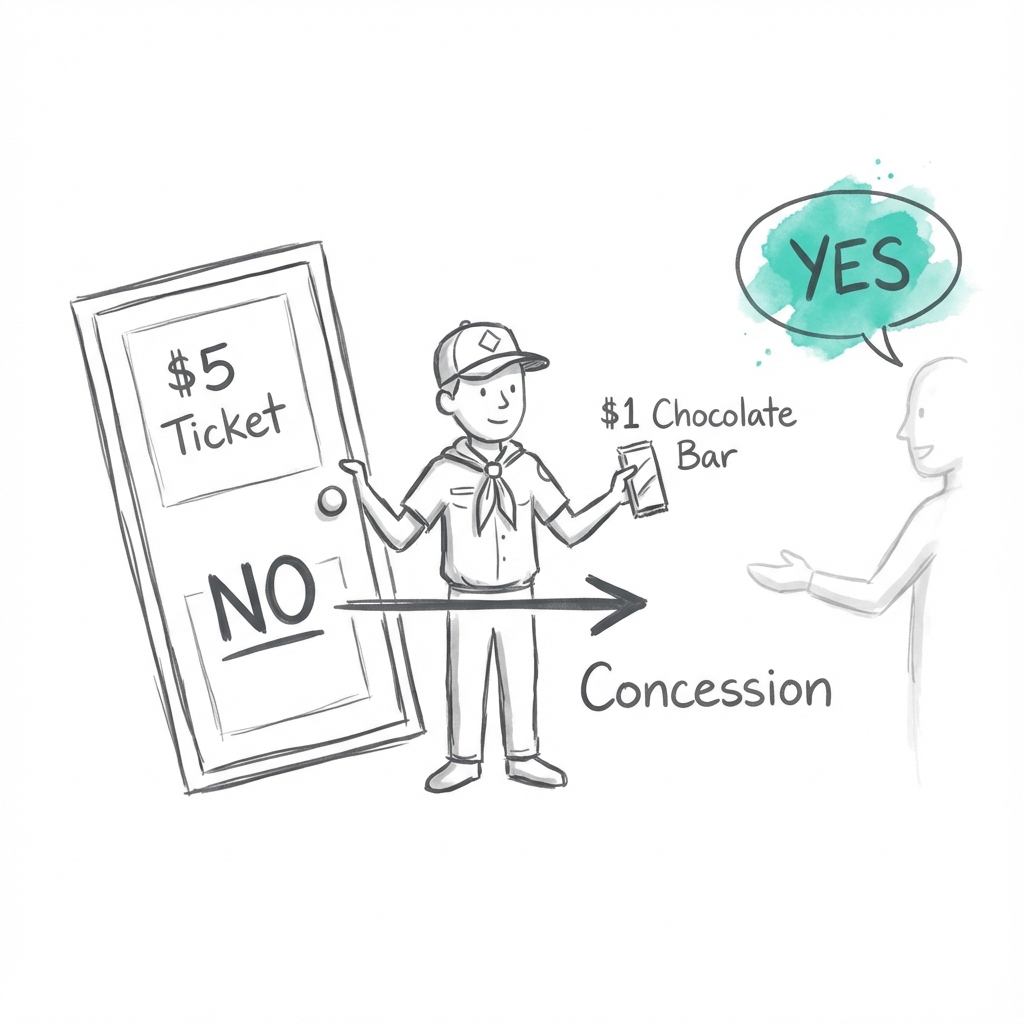
The rule also governs concessions.
If someone makes a concession to us, we feel obligated to make a concession in return.
I once ran into a Boy Scout on the street. He asked if I wanted to buy a ticket to the Boy Scout Circus for $5. I wasn't interested. I declined. But the Boy Scout had made a concession. He retreated from his large request to a smaller one. To satisfy the rule, I had to make a concession of my own. I moved from "no" to "yes."
This is the Rejection-Then-Retreat technique.
You make a large request that will likely be refused. After the refusal, you retreat to the smaller request you were interested in all along.
The target views this as a compromise and feels bound to accept it. It is a case of heads I win, tails you lose.
How to Say No
The enemy is not the requester. The enemy is the rule.
If you reject every favor, you risk insulting innocent people who are just being kind. A policy of blanket rejection is socially isolating.
The solution is redefinition.
Accept the initial offer.
If a fire inspector gives you a free fire extinguisher, take it. Thank him. But if he then launches into a high-pressure sales pitch for an alarm system, you must perform a mental maneuver.
Define what you received not as a gift, but as a sales device.
The reciprocity rule states that favors should be met with favors. It does not require that tricks be met with favors. By redefining the action, you strip it of its power. You are free to decline the purchase without a tug of guilt.
In fact, if you want to be thorough, take the free gift and show him the door. After all, the rule implies that exploitation attempts should be exploited.