During the Lebanese civil war, Nassim Taleb watched his grandmother do something strange.
She would sit on her balcony in Amioun, staring at the buildings across the valley. After a shelling, she would point at a structure that looked perfectly intact.
"That one is next," she would say.
She had no engineering degree. No stress-test models. No data. Just eighty years of watching things break.
She was almost always right.
The building that looked fine had invisible cracks running through its foundation. The next tremor finished it off.
Meanwhile, the older, rougher structures that had already survived a dozen small earthquakes kept standing.
Taleb spent thirty years trying to understand what his grandmother saw. How do some things get stronger from stress while others shatter? Why do the systems we build to be safe often become the most dangerous? And why does our language lack a word for the opposite of fragile?
The answer is the core thesis of his book, Antifragile.
We have built a modern world obsessed with eliminating volatility. We smooth out the business cycle. We medicate every minor symptom. We put out every small forest fire.
We think we are making the world safer.
We are making it a bomb.
By suppressing small stressors, we deprive complex systems of the information they need to adapt.
We trade frequent, survivable errors for rare, catastrophic ones. We create the conditions for the very disasters we fear.
Taleb's grandmother understood this intuitively. Some things need to be shaken to stay strong. The goal is to become one of them.
This longform is a map for navigating a world you cannot predict.
By the end, you will discover:
- Why the opposite of fragile isn't "robust." It's something we don't even have a word for.
- Why trying to fix complex systems often causes more harm than doing nothing.
- Why you should be hyper-safe with 90% of your life and hyper-aggressive with 10%.
- Why you don't need to predict the future to benefit from it.
- Why what you remove from your life matters more than what you add.
- Why anyone giving you advice should be forced to eat their own cooking.
The 1-Minute Summary
Some things break under stress, some survive, and a third category gets stronger.
Taleb calls this the Antifragile.
Your body is antifragile. Lift heavy weights and your muscles grow. Your immune system is antifragile. Expose it to small doses of pathogens and it learns.
But modernity treats the world like a fragile teacup. We eliminate volatility, suppress small failures, and medicate every minor symptom.
The core problem
By silencing noise, we stop systems from learning. We trade frequent, survivable shocks for rare, catastrophic Black Swans.
The 2008 financial crisis wasn't caused by the trigger. It was caused by decades of suppressing small bank failures until the system exploded all at once.
The core shift
Stop trying to predict the future. It's a fool's game. Instead, position yourself to benefit from whatever happens.
- Optionality: Structure your life so you have limited downside and unlimited upside. You don't need to know what will happen. You just need to be positioned to gain from surprises.
- The Barbell Strategy: Be hyper-safe with 90% of your resources. Be hyper-aggressive with 10%. Avoid the middle.
- Via Negativa: Improve by subtraction. Remove debt, sugar, and the illusion of control. What you don't do matters more than what you add.
The goal is to become the fire that is fed by the wind, not the candle that is extinguished by it.
Module 1
The Triad
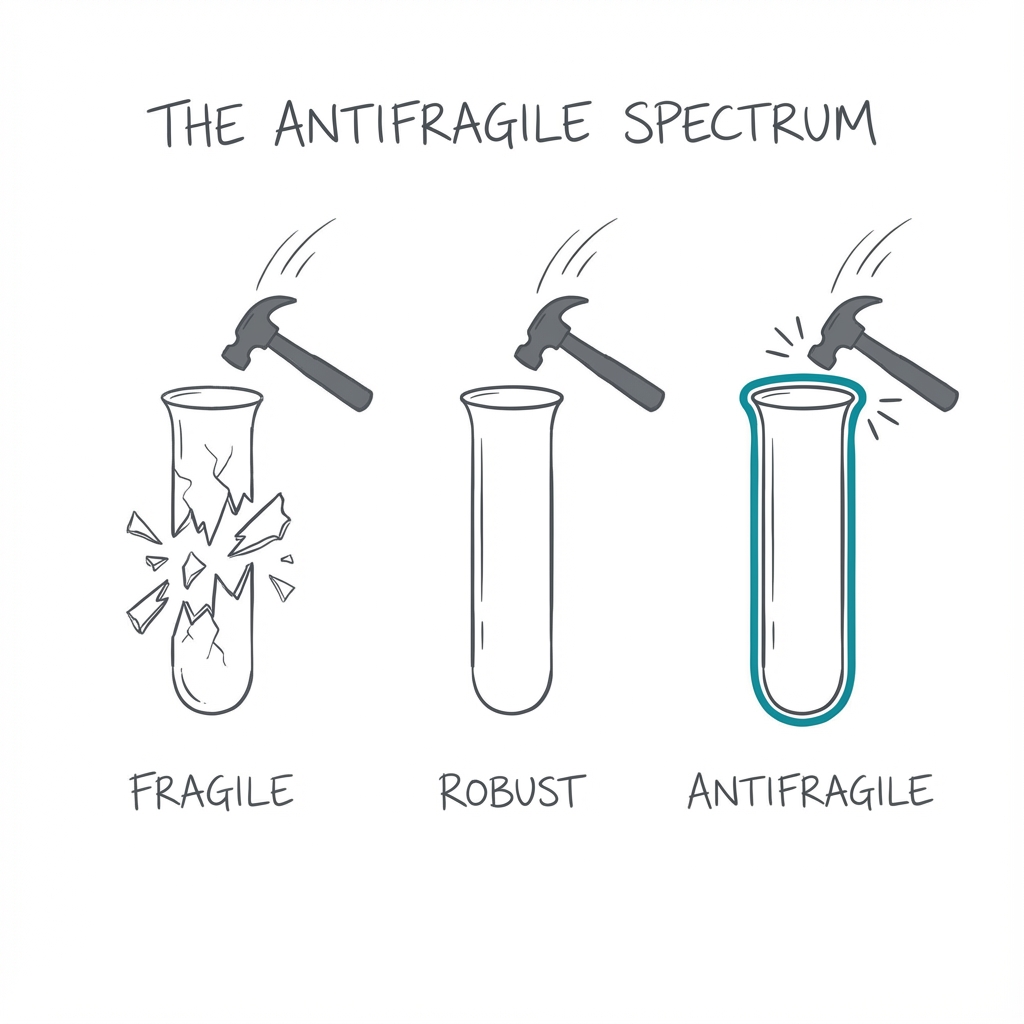
Walk into a post office with a box of champagne glasses. You stamp it with red letters: Fragile.
This instruction is clear: Avoid shocks. Avoid disorder. Keep this predictable.
Now, imagine you have a box containing a heavy iron anvil. You don't need a stamp. If the mail carrier drops it, nothing happens. It is Robust.
But what is the exact opposite of the box of glasses?
Most people answer robust or resilient. This is a logic error that blinds us to the reality of the world.
The opposite of harm is not no harm. It is benefit.
The opposite of negative is positive, not neutral.
The exact opposite of the Fragile package would be a package stamped: Please Mishandle.
It would be a package that wants to be dropped, kicked, and exposed to heat and cold.
Every shock makes the contents more valuable.
We don't have a word for this in English. So Taleb coined one: Antifragile.
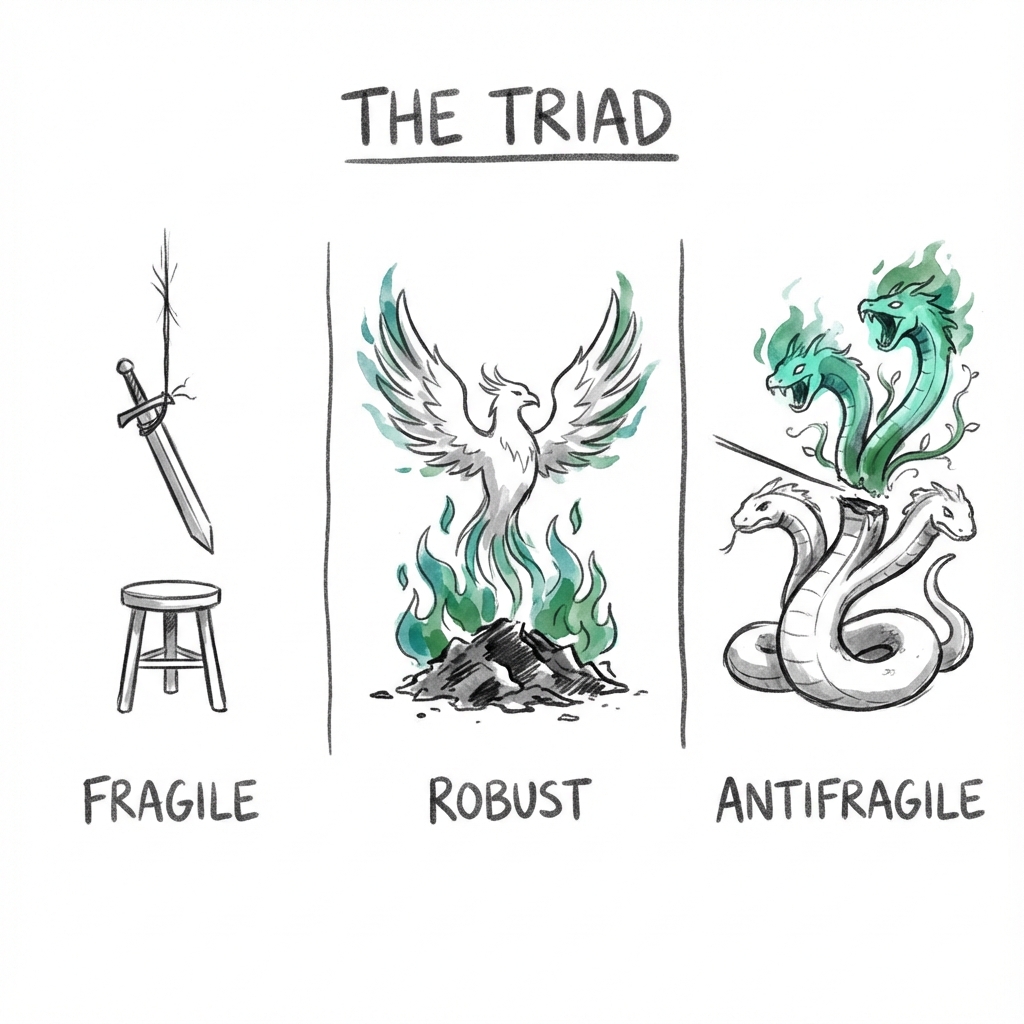
To understand the world, we must map everything onto the Triad:
-
The Fragile (Damocles): Think of Damocles, the courtier who sat beneath a sword suspended by a single horsehair. He had power, wealth, and comfort. But one invisible stressor (the snapping of a hair) and it's all over. The Fragile wants tranquility. It hates volatility. It requires a predictable environment to survive. A porcelain cup. A highly indebted bank. A centralized bureaucracy. A long-term plan. Time and disorder hurt it.
-
The Robust (The Phoenix): The Phoenix dies in flames and is reborn from its ashes. It returns to its exact previous state. It survives the shock, but it doesn't grow from it. The Robust is indifferent to volatility. It absorbs shocks and stays the same. A rock. A diamond. A well-diversified portfolio. Time and disorder do nothing to it.
-
The Antifragile (The Hydra): The Hydra is a serpent-like creature from Greek mythology. When you cut off one of its heads, two grow back in its place. It doesn't just survive harm. It benefits from it. The Antifragile grows from disorder. It feeds on volatility. Evolution. Your immune system. Time and disorder strengthen it.
The Biological Imperative
The easiest place to see antifragility is in your own body.
If you spend a month in bed to save your energy, you will not become robust. You will atrophy. Your muscles will waste away and your bones will become brittle.
The human body is not a machine that wears out with use. It is an organic system that requires stressors to function.
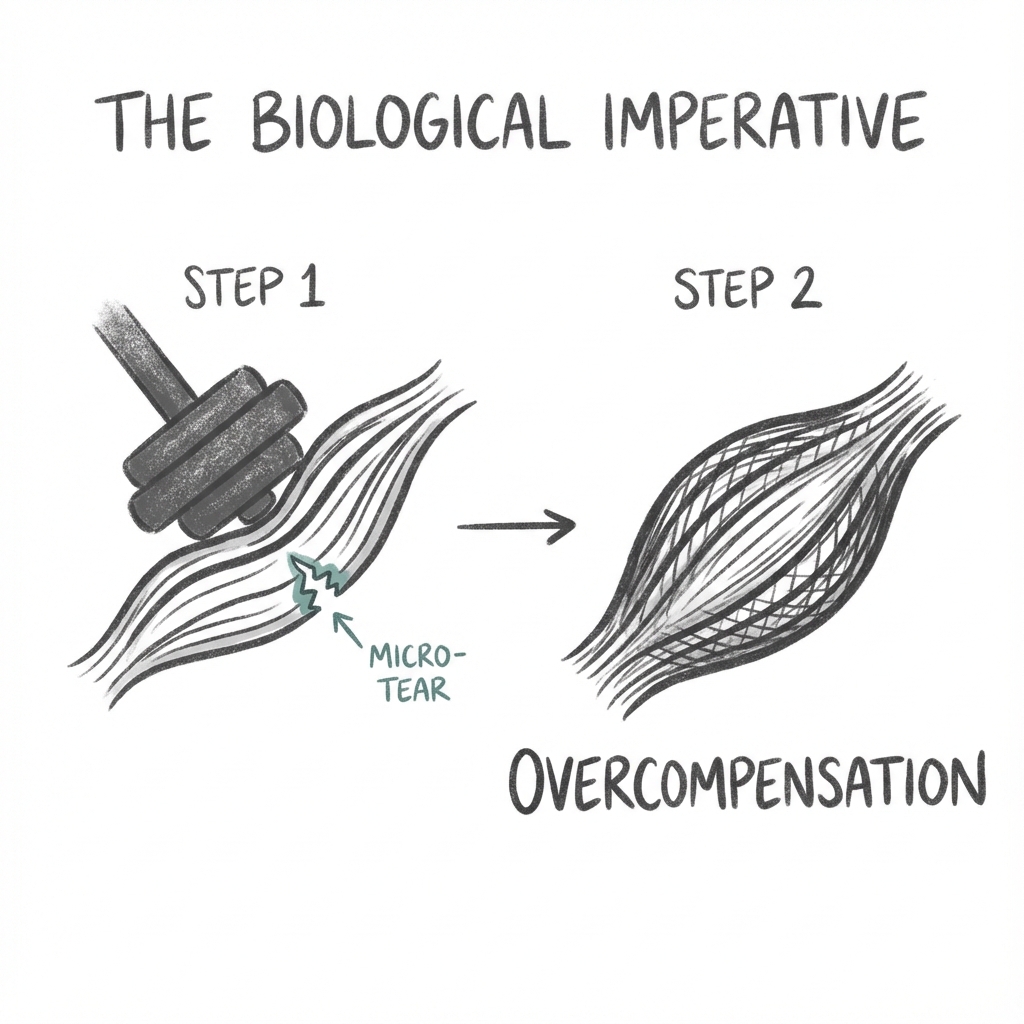
When you lift heavy weights, you create micro-tears in your muscle fibers. You are technically harming yourself.
But your body overcompensates for the shock, rebuilding the muscle stronger than it was before.
Resilience resists shocks and stays the same. Antifragility goes further. It gets better.
Domain Dependence
The great irony is that we understand this concept perfectly in some areas of life, and completely ignore it in others.
We suffer from Domain Dependence.
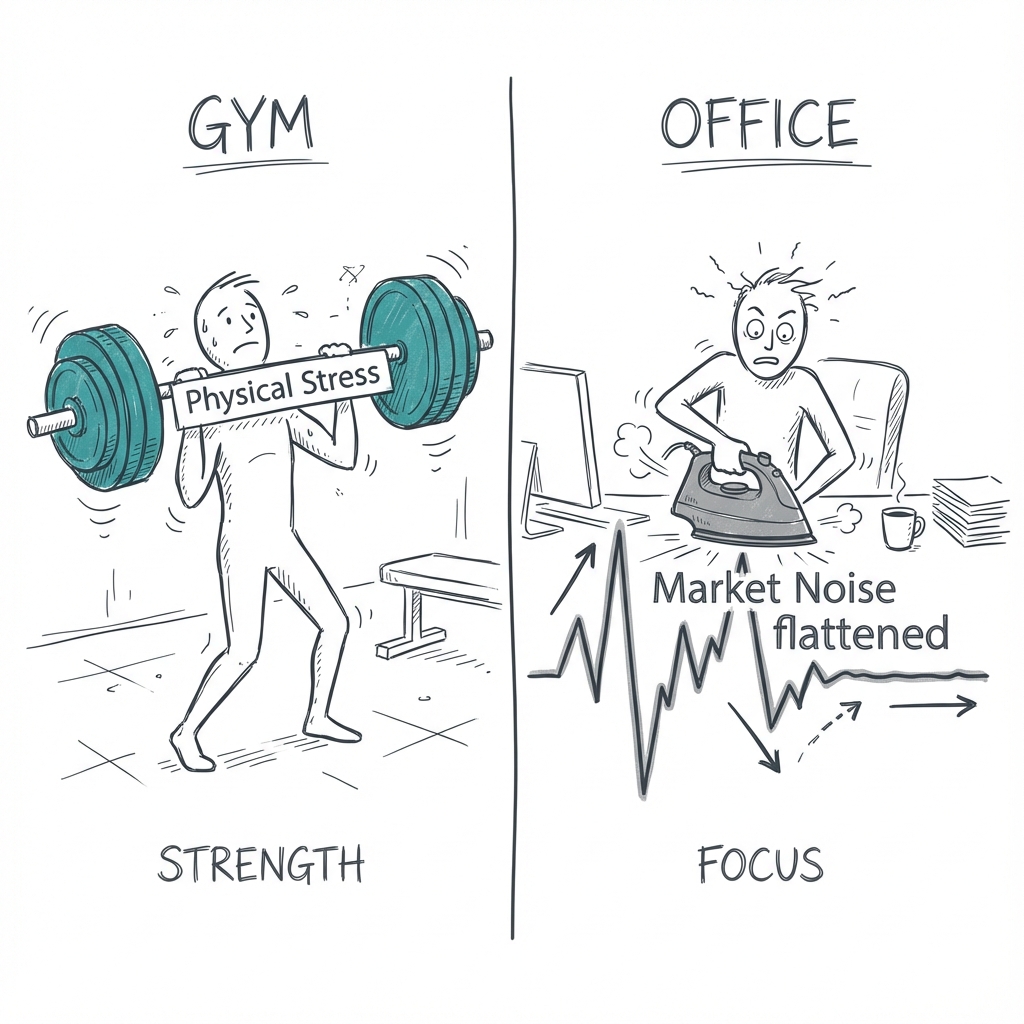
Taleb describes seeing a banker in a luxury hotel in Dubai. The porter carries the banker's luggage because the banker is too important to exert himself.
But an hour later, Taleb sees the same banker in the gym. He is sweating and lifting heavy iron weights to simulate the stress of lifting luggage.
The banker understands that his body needs stress to stay healthy.
Yet, in his professional life, he spends his day trying to eliminate all volatility from the market.
He is creating a system that is terrified of ups and downs. He removes the stressors from the economy, thinking he is making it safer.
He doesn't realize that by smoothing out the economy, he is putting it in a hospital bed. He is causing it to atrophy.
He is ensuring that when the next shock comes, the patient will die.
Stress Is Information
Why does the antifragile need stress? Because in complex systems, noise and volatility act as information.
Consider the restaurant business. It is brutally competitive. Individual restaurants are fragile. They go bankrupt constantly.
But this constant turnover ensures that the restaurant industry as a whole is incredibly competent and antifragile. Bad food and bad service are punished immediately.
The failure of the parts communicates information to the whole. This forces the remaining restaurants to adapt and improve.
Now consider the banking system. When a bank fails, the government intervenes and bails it out. They suppress the failure. They kill the stressor.
By preventing the noise of small failures, the system never learns. It accumulates hidden risks. Taleb calls these Silent Risks. They grow until the entire system collapses at once.
When you deprive a system of stressors, you don't make it stable. You make it a bomb with a delayed fuse.